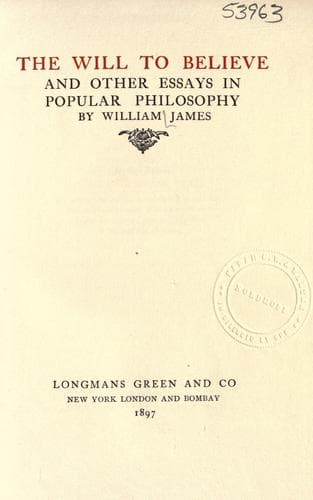
The Will to Believe, and Other Essays in Popular PhilosophyJames, William
Religion
The Will to Believe, and Other Essays in Popular Philosophy
James, William
Belief and doubt; Essays; Philosophy
Mr. Allen's contempt for hero-worship is based on very simple
considerations. A nation's great men, he says, are but slight
deviations from the general level. The hero is merely a special
complex of the ordinary qualities of his race. The petty differences
impressed upon ordinary Greek minds by Plato or Aristotle or Zeno, are
nothing at all compared with the vast differences between every Greek
mind and every Egyptian or Chinese mind. We may neglect them in a
philosophy of history, just as in calculating the impetus of a
locomotive we neglect the extra impetus given by a single piece of
better coal. What each man adds is but an infinitesimal fraction
compared with what he derives from his parents, or {256} indirectly
from his earlier ancestry. And if what the past gives to the hero is
so much bulkier than what the future receives from him, it is what
really calls for philosophical treatment. The problem for the
sociologist is as to what produces the average man; the extraordinary
men and what they produce may by the philosophers be taken for granted,
as too trivial variations to merit deep inquiry.
Now, as I wish to vie with Mr. Allen's unrivalled polemic amiability
and be as conciliatory as possible, I will not cavil at his facts or
try to magnify the chasm between an Aristotle, a Goethe, or a Napoleon
and the average level of their respective tribes. Let it be as small
as Mr. Allen thinks. All that I object to is that he should think the
mere _size_ of a difference is capable of deciding whether that
difference be or be not a fit subject for philosophic study. Truly
enough, the details vanish in the bird's-eye view; but so does the
bird's-eye view vanish in the details. Which is the right point of
view for philosophic vision? Nature gives no reply, for both points of
view, being equally real, are equally natural; and no one natural
reality _per se_ is any more emphatic than any other. Accentuation,
foreground, and background are created solely by the interested
attention of the looker-on; and if the small difference between the
genius and his tribe interests me most, while the large one between
that tribe and another tribe interests Mr. Allen, our controversy
cannot be ended until a complete philosophy, accounting for all
differences impartially, shall justify us both.
An unlearned carpenter of my acquaintance once said in my hearing:
"There is very little difference between one man and another; but what
little there {257} is, _is very important_." This distinction seems to
me to go to the root of the matter. It is not only the size of the
difference which concerns the philosopher, but also its place and its
kind. An inch is a small thing, but we know the proverb about an inch
on a man's nose. Messrs. Allen and Spencer, in inveighing against
hero-worship, are thinking exclusively of the size of the inch; I, as a
hero-worshipper, attend to its seat and function.
Public-domain text, read in full here on John Shaqi.
Reviews
Reviews
No reviews yet
Be the first to share your thoughts on this work.
Elsewhere in the archive
Join the Discussion
Join the discussion
Sign in to leave a comment or review.
Sign InorCreate an account