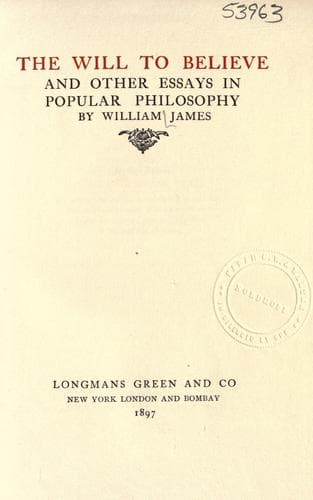
The Will to Believe, and Other Essays in Popular PhilosophyJames, William
Religion
The Will to Believe, and Other Essays in Popular Philosophy
James, William
Belief and doubt; Essays; Philosophy
{263}
ON SOME HEGELISMS.[1]
We are just now witnessing a singular phenomenon in British and
American philosophy. Hegelism, so defunct on its native soil that I
believe but a single youthful disciple of the school is to be counted
among the privat-docenten and younger professors of Germany, and whose
older champions are all passing off the stage, has found among us so
zealous and able a set of propagandists that to-day it may really be
reckoned one of the most powerful influences of the time in the higher
walks of thought. And there is no doubt that, as a movement of
reaction against the traditional British empiricism, the hegelian
influence represents expansion and freedom, and is doing service of a
certain kind. Such service, however, ought not to make us blindly
indulgent. Hegel's philosophy mingles mountain-loads of corruption
with its scanty merits, and must, now that it has become
quasi-official, make ready to defend itself as well as to attack
others. It is with no hope of converting independent thinkers, but
rather with the sole aspiration of showing some chance youthful
disciple that there _is_ another point of view in philosophy that I
fire this skirmisher's shot, which may, I hope, soon be followed by
somebody else's heavier musketry.
{264}
The point of view I have in mind will become clearer if I begin with a
few preparatory remarks on the motives and difficulties of
philosophizing in general.
To show that the real is identical with the ideal may roughly be set
down as the mainspring of philosophic activity. The atomic and
mechanical conception of the world is as ideal from the point of view
of some of our faculties as the teleological one is from the point of
view of others. In the realm of every ideal we can begin anywhere and
roam over the field, each term passing us to its neighbor, each member
calling for the next, and our reason rejoicing in its glad activity.
Where the parts of a conception seem thus to belong together by inward
kinship, where the whole is defined in a way congruous with our powers
of reaction, to see is to approve and to understand.
Public-domain text, read in full here on John Shaqi.
Reviews
Reviews
No reviews yet
Be the first to share your thoughts on this work.
Elsewhere in the archive
Join the Discussion
Join the discussion
Sign in to leave a comment or review.
Sign InorCreate an account