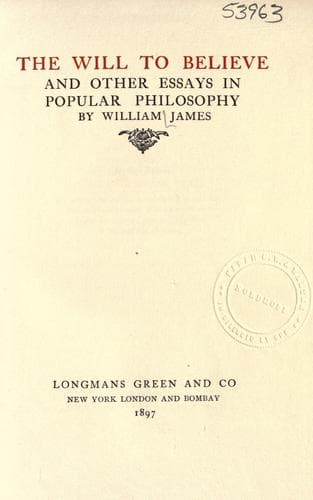
The Will to Believe, and Other Essays in Popular PhilosophyJames, William
Religion
The Will to Believe, and Other Essays in Popular Philosophy
James, William
Belief and doubt; Essays; Philosophy
And is not its instinct right? Do not we here grasp the
race-differences _in the making_, and catch the only glimpse it is
allotted to us to attain of the working units themselves, of whose
differentiating action the race-gaps form but the stagnant sum? What
strange inversion of scientific procedure does Mr. Allen practise when
he teaches us to neglect elements and attend only to aggregate
resultants? On the contrary, simply because the active ring, whatever
its bulk, _is elementary_, I hold that the study of its conditions (be
these never so 'proximate') is the highest of topics for the social
philosopher. If individual variations determine its ups and downs and
hair-breadth escapes and twists and turns, as Mr. Allen and Mr. Fiske
both admit, Heaven forbid us from tabooing the study of these in favor
of the average! On the contrary, let us emphasize these, and the
importance of these; and in picking out from history our heroes, and
communing with their {261} kindred spirits,--in imagining as strongly
as possible what differences their individualities brought about in
this world, while its surface was still plastic in their hands, and
what whilom feasibilities they made impossible,--each one of us may
best fortify and inspire what creative energy may lie in his own
soul.[1]
This is the lasting justification of hero-worship, and the pooh-poohing
of it by 'sociologists' is the ever-lasting excuse for popular
indifference to their general laws and averages. The difference
between an America rescued by a Washington or by a 'Jenkins' may, as
Mr. Allen says, be 'little,' but it is, in the words of my carpenter
friend, 'important.' Some organizing genius must in the nature of
things have emerged from the French Revolution; but what Frenchman will
affirm it to have been an accident of no consequence that he should
have had the supernumerary idiosyncrasies of a Bonaparte? What animal,
domestic or wild, will call it a matter of no moment that scarce a word
of sympathy with brutes should have survived from the teachings of
Jesus of Nazareth?
The preferences of sentient creatures are what _create_ the importance
of topics. They are the absolute and ultimate law-giver here. And I
for my part cannot but consider the talk of the contemporary
sociological school about averages and general laws and predetermined
tendencies, with its obligatory undervaluing of the importance of
individual {262} differences, as the most pernicious and immoral of
fatalisms. Suppose there is a social equilibrium fated to be, whose is
it to be,--that of your preference, or mine? There lies the question
of questions, and it is one which no study of averages can decide.
[1] M. G. Tarde's book (itself a work of genius), Les Lois de
l'Imitation, Étude Sociologique (2me Édition, Paris, Alcan, 1895), is
the best possible commentary on this text,--'invention' on the one
hand, and 'imitation' on the other, being for this author the two sole
factors of social change.
Public-domain text, read in full here on John Shaqi.
Reviews
Reviews
No reviews yet
Be the first to share your thoughts on this work.
Elsewhere in the archive
Join the Discussion
Join the discussion
Sign in to leave a comment or review.
Sign InorCreate an account