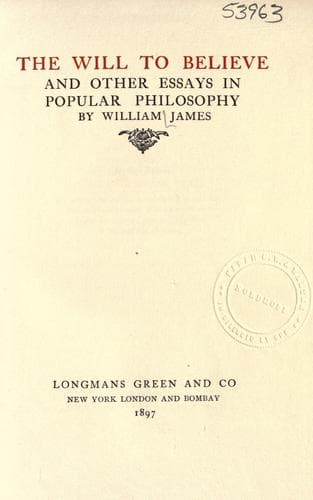
The Will to Believe, and Other Essays in Popular PhilosophyJames, William
Religion
The Will to Believe, and Other Essays in Popular Philosophy
James, William
Belief and doubt; Essays; Philosophy
To me this view seems deeply probable. Things cohere, but the act of
cohesion itself implies but few conditions, and leaves the rest of
their qualifications indeterminate. As the first three notes of a tune
comport many endings, all melodious, but the tune is not named till a
particular ending has actually come,--so the parts actually known of
the universe may comport many ideally possible complements. But as
{271} the facts are not the complements, so the knowledge of the one is
not the knowledge of the other in anything but the few necessary
elements of which all must partake in order to be together at all.
Why, if one act of knowledge could from one point take in the total
perspective, with all mere possibilities abolished, should there ever
have been anything more than that act? Why duplicate it by the tedious
unrolling, inch by inch, of the foredone reality? No answer seems
possible. On the other hand, if we stipulate only a partial community
of partially independent powers, we see perfectly why no one part
controls the whole view, but each detail must come and be actually
given, before, in any special sense, it can be said to be determined at
all. This is the moral view, the view that gives to other powers the
same freedom it would have itself,--not the ridiculous 'freedom to do
right,' which in my mouth can only mean the freedom to do as _I_ think
right, but the freedom to do as _they_ think right, or wrong either.
After all, what accounts do the nether-most bounds of the universe owe
to me? By what insatiate conceit and lust of intellectual despotism do
I arrogate the right to know their secrets, and from my philosophic
throne to play the only airs they shall march to, as if I were the
Lord's anointed? Is not my knowing them at all a gift and not a right?
And shall it be given before they are given? _Data! gifts!_ something
to be thankful for! It is a gift that we can approach things at all,
and, by means of the time and space of which our minds and they
partake, alter our actions so as to meet them.
There are 'bounds of ord'nance' set for all things, where they must
pause or rue it. 'Facts' are the bounds of human knowledge, set for
it, not by it.
{272}
Public-domain text, read in full here on John Shaqi.
Reviews
Reviews
No reviews yet
Be the first to share your thoughts on this work.
Elsewhere in the archive
Join the Discussion
Join the discussion
Sign in to leave a comment or review.
Sign InorCreate an account