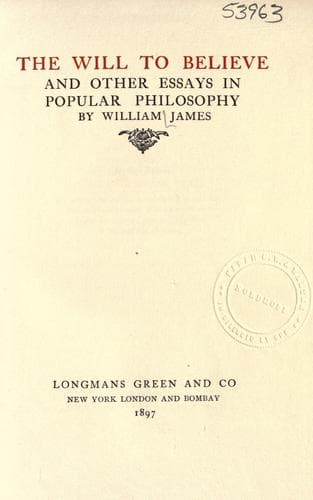
The Will to Believe, and Other Essays in Popular PhilosophyJames, William
Religion
The Will to Believe, and Other Essays in Popular Philosophy
James, William
Belief and doubt; Essays; Philosophy
Now, to a mind like Hegel's such pusillanimous twaddle sounds simply
loathsome. Bounds that we can't overpass! Data! facts that say,
"Hands off, till we are given"! possibilities we can't control! a
banquet of which we merely share! Heavens, this is intolerable; such a
world is no world for a philosopher to have to do with. He must have
all or nothing. If the world cannot be rational in my sense, in the
sense of unconditional surrender, I refuse to grant that it is rational
at all. It is pure incoherence, a chaos, a nulliverse, to whose
haphazard sway I will not truckle. But, no! this is not the world.
The world is philosophy's own,--a single block, of which, if she once
get her teeth on any part, the whole shall inevitably become her prey
and feed her all-devouring theoretic maw. Naught shall be but the
necessities she creates and impossibilities; freedom shall mean freedom
to obey her will, ideal and actual shall be one: she, and I as her
champion, will be satisfied on no lower terms.
The insolence of sway, the _hubris_ on which gods take vengeance, is in
temporal and spiritual matters usually admitted to be a vice. A
Bonaparte and a Philip II. are called monsters. But when an
_intellect_ is found insatiate enough to declare that all existence
must bend the knee to its requirements, we do not call its owner a
monster, but a philosophic prophet. May not this be all wrong? Is
there any one of our functions exempted from the common lot of
liability to excess? And where everything else must be contented with
its part in the universe, shall the theorizing faculty ride rough-shod
over the whole?
I confess I can see no _à priori_ reason for the exception. He who
claims it must be judged by the {273} consequences of his acts, and by
them alone. Let Hegel then confront the universe with his claim, and
see how he can make the two match.
The universe absolutely refuses to let him travel without jolt. Time,
space, and his ego are continuous; so are degrees of heat, shades of
light and color, and a few other serial things; so too do potatoes call
for salt, and cranberries for sugar, in the taste of one who knows what
salt and sugar are. But on the whole there is nought to soften the
shock of surprise to his intelligence, as it passes from one quality of
being to another. Light is not heat, heat is not light; and to him who
holds the one the other is not given till it give itself. Real being
comes moreover and goes from any concept at its own sweet will, with no
permission asked of the conceiver. In despair must Hegel lift vain
hands of imprecation; and since he will take nothing but the whole, he
must throw away even the part he might retain, and call the nature of
things an _absolute_ muddle and incoherence.
Public-domain text, read in full here on John Shaqi.
Reviews
Reviews
No reviews yet
Be the first to share your thoughts on this work.
Elsewhere in the archive
Join the Discussion
Join the discussion
Sign in to leave a comment or review.
Sign InorCreate an account