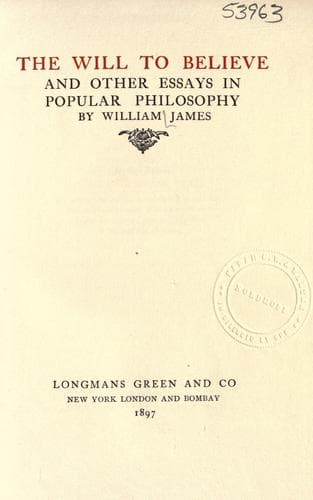
The Will to Believe, and Other Essays in Popular PhilosophyJames, William
Religion
The Will to Believe, and Other Essays in Popular Philosophy
James, William
Belief and doubt; Essays; Philosophy
But if the man ask how self-contradiction _can_ do all this, and how
its dynamism may be seen to work, Hegel can only reply by showing him
the space itself and saying: "Lo, _thus_." In other words, instead of
the principle of explanation being more intelligible than the thing to
be explained, it is absolutely unintelligible if taken by itself, and
must appeal to its pretended product to prove its existence. Surely,
such a system of explaining _notum per ignotum_, of {277} making the
_explicans_ borrow credentials from the _explicand_, and of creating
paradoxes and impossibilities where none were suspected, is a strange
candidate for the honor of being a complete rationalizer of the world.
The principle of the contradictoriness of identity and the identity of
contradictories is the essence of the hegelian system. But what
probably washes this principle down most with beginners is the
combination in which its author works it with another principle which
is by no means characteristic of his system, and which, for want of a
better name, might be called the 'principle of totality.' This
principle says that you cannot adequately know even a part until you
know of what whole it forms a part. As Aristotle writes and Hegel
loves to quote, an amputated hand is not even a hand. And as Tennyson
says,--
"Little flower--but if I could understand
What you are, root and all, and all in all,
I should know what God and man is."
Obviously, until we have taken in all the relations, immediate or
remote, into which the thing actually enters or potentially may enter,
we do not know all _about_ the thing.
And obviously for such an exhaustive acquaintance with the thing, an
acquaintance with every other thing, actual and potential, near and
remote, is needed; so that it is quite fair to say that omniscience
alone can completely know any one thing as it stands. Standing in a
world of relations, that world must be known before the thing is fully
known. This doctrine is of course an integral part of empiricism, an
integral part of common-sense. Since when could good men not apprehend
the passing hour {278} in the light of life's larger sweep,--not grow
dispassionate the more they stretched their view? Did the 'law of
sharing' so little legitimate their procedure that a law of identity of
contradictories, forsooth, must be trumped up to give it scope? Out
upon the idea!
Public-domain text, read in full here on John Shaqi.
Reviews
Reviews
No reviews yet
Be the first to share your thoughts on this work.
Elsewhere in the archive
Join the Discussion
Join the discussion
Sign in to leave a comment or review.
Sign InorCreate an account