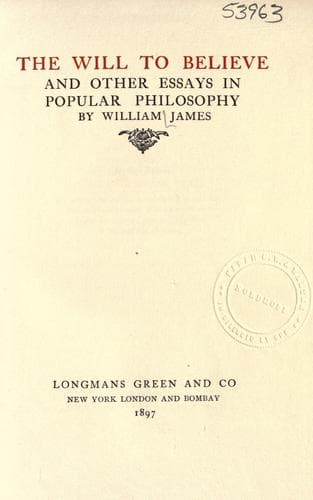
The Will to Believe, and Other Essays in Popular PhilosophyJames, William
Religion
The Will to Believe, and Other Essays in Popular Philosophy
James, William
Belief and doubt; Essays; Philosophy
Hume's account of causation is a good illustration of the way in which
empiricism may use the principle of totality. We call something a
cause; but we at the same time deny its effect to be in any latent way
contained in or substantially identical with it. We thus cannot tell
what its causality amounts to until its effect has actually supervened.
The effect, then, or something beyond the thing is what makes the thing
to be so far as it is a cause. Humism thus says that its causality is
something adventitious and not necessarily given when its other
attributes are there. Generalizing this, empiricism contends that we
must everywhere distinguish between the intrinsic being of a thing and
its relations, and, among these, between those that are essential to
our knowing it at all and those that may be called adventitious. The
thing as actually present in a given world is there with _all_ its
relations; for it to be known as it _there_ exists, they must be known
too, and it and they form a single fact for any consciousness large
enough to embrace that world as a unity. But what constitutes this
singleness of fact, this unity? Empiricism says, Nothing but the
relation-yielding matrix in which the several items of the world find
themselves embedded,--time, namely, and space, and the mind of the
knower. And it says that were some of the items quite different from
what they are and others the same, still, for aught we can see, an
equally unitary world might be, provided each {279} item were an object
for consciousness and occupied a determinate point in space and time.
All the adventitious relations would in such a world be changed, along
with the intrinsic natures and places of the beings between which they
obtained; but the 'principle of totality' in knowledge would in no wise
be affected.
Public-domain text, read in full here on John Shaqi.
Reviews
Reviews
No reviews yet
Be the first to share your thoughts on this work.
Elsewhere in the archive
Join the Discussion
Join the discussion
Sign in to leave a comment or review.
Sign InorCreate an account