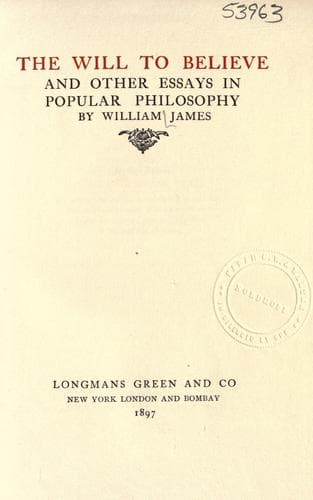
The Will to Believe, and Other Essays in Popular PhilosophyJames, William
Religion
The Will to Believe, and Other Essays in Popular Philosophy
James, William
Belief and doubt; Essays; Philosophy
But Hegelism dogmatically denies all this to be possible. In the first
place it says there are no intrinsic natures that may change; in the
second it says there are no adventitious relations. When the relations
of what we call a thing are told, no _caput mortuum_ of intrinsicality,
no 'nature,' is left. The relations soak up all there is of the thing;
the 'items' of the world are but _foci_ of relation with other _foci_
of relation; and all the relations are necessary. The unity of the
world has nothing to do with any 'matrix.' The matrix and the items,
each with all, make a unity, simply because each in truth is all the
rest. The proof lies in the _hegelian_ principle of totality, which
demands that if any one part be posited alone all the others shall
forthwith _emanate_ from it and infallibly reproduce the whole. In the
_modus operandi_ of the emanation comes in, as I said, that partnership
of the principle of totality with that of the identity of
contradictories which so recommends the latter to beginners in Hegel's
philosophy. To posit one item alone is to deny the rest; to deny them
is to refer to them; to refer to them is to begin, at least, to bring
them on the scene; and to begin is in the fulness of time to end.
If we call this a monism, Hegel is quick to cry, Not so! To say simply
that the one item is the rest {280} of the universe is as false and
one-sided as to say that it is simply itself. It is both and neither;
and the only condition on which we gain the right to affirm that it is,
is that we fail not to keep affirming all the while that it is not, as
well. Thus the truth refuses to be expressed in any single act of
judgment or sentence. The world appears as a monism _and_ a pluralism,
just as it appeared in our own introductory exposition.
But the trouble that keeps us and Hegel from ever joining hands over
this apparent formula of brotherhood is that we distinguish, or try to
distinguish, the respects in which the world is one from those in which
it is many, while all such stable distinctions are what he most
abominates. The reader may decide which procedure helps his reason
most. For my own part, the time-honored formula of empiricist
pluralism, that the world cannot be set down in any single proposition,
grows less instead of more intelligible when I add, "And yet the
different propositions that express it are one!" The unity of the
propositions is that of the mind that harbors them. Any one who
insists that their diversity is in any way itself their unity, can only
do so because he loves obscurity and mystification for their own pure
sakes.
Public-domain text, read in full here on John Shaqi.
Reviews
Reviews
No reviews yet
Be the first to share your thoughts on this work.
Elsewhere in the archive
Join the Discussion
Join the discussion
Sign in to leave a comment or review.
Sign InorCreate an account