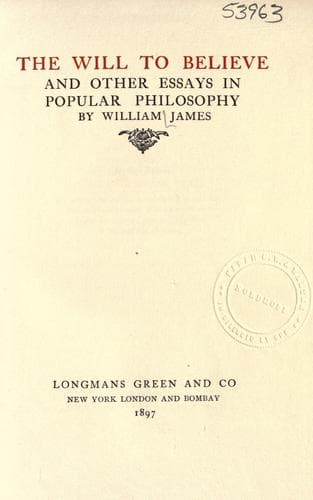
The Will to Believe, and Other Essays in Popular PhilosophyJames, William
Religion
The Will to Believe, and Other Essays in Popular Philosophy
James, William
Belief and doubt; Essays; Philosophy
Of course we may in this instance or any other repeat that the
conclusion is strictly true, however comical it seems. Man within the
clothes is naked, just as he is without them. Man would never have
invented the clothes had he not been naked. The fact of his being clad
at all does prove his essential nudity. And so in general,--the form
of any judgment, being the addition of a predicate to a subject, shows
that the subject has been conceived without the predicate, and thus by
a strained metaphor may {282} be called the predicate's negation. Well
and good! let the expression pass. But we must notice this. The
judgment has now created a new subject, the naked-clad, and all
propositions regarding this must be judged on their own merits; for
those true of the old subject, 'the naked,' are no longer true of this
one. For instance, we cannot say because the naked pure and simple
must not enter the drawing-room or is in danger of taking cold, that
the naked with his clothes on will also take cold or must stay in his
bedroom. Hold to it eternally that the clad man _is_ still naked if it
amuse you,--'tis designated in the bond; but the so-called
contradiction is a sterile boon. Like Shylock's pound of flesh, it
leads to no consequences. It does not entitle you to one drop of his
Christian blood either in the way of catarrh, social exclusion, or what
further results pure nakedness may involve.
In a version of the first step given by our foremost American
Hegelian,[4] we find this playing with the necessary form of judgment.
Pure being, he says, has no determinations. But the having none is
itself a determination. Wherefore pure being contradicts its own self,
and so on. Why not take heed to the _meaning_ of what is said? When
we make the predication concerning pure being, our meaning is merely
the denial of all other determinations than the particular one we make.
The showman who advertised his elephant as 'larger than any elephant in
the world except himself' must have been in an hegelian country where
he was afraid that if he were less explicit the audience would
dialectically proceed to say: {283} "This elephant, larger than any in
the world, involves a contradiction; for he himself is in the world,
and so stands endowed with the virtue of being both larger and smaller
than himself,--a perfect hegelian elephant, whose immanent
self-contradictoriness can only be removed in a higher synthesis. Show
us the higher synthesis! We don't care to see such a mere abstract
creature as your elephant." It may be (and it was indeed suggested in
antiquity) that all things are of their own size by being both larger
and smaller than themselves. But in the case of this elephant the
scrupulous showman nipped such philosophizing and all its inconvenient
consequences in the bud, by explicitly intimating that larger than any
_other_ elephant was all he meant.
Public-domain text, read in full here on John Shaqi.
Reviews
Reviews
No reviews yet
Be the first to share your thoughts on this work.
Elsewhere in the archive
Join the Discussion
Join the discussion
Sign in to leave a comment or review.
Sign InorCreate an account