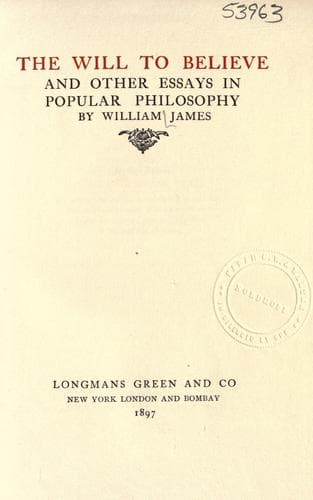
The Will to Believe, and Other Essays in Popular PhilosophyJames, William
Religion
The Will to Believe, and Other Essays in Popular Philosophy
James, William
Belief and doubt; Essays; Philosophy
Hegel's quibble with this word _other_ exemplifies the same fallacy.
All 'others,' as such, are according to him identical. That is,
'otherness,' which can only be predicated of a given thing _A_,
_secundum quid_ (as other than _B_, etc.), is predicated _simpliciter_,
and made to identify the _A_ in question with _B_, which is other only
_secundum aliud_,--namely other than _A_.
Another maxim that Hegelism is never tired of repeating is that "to
know a limit is already to be beyond it." "Stone walls do not a prison
make, nor iron bars a cage." The inmate of the penitentiary shows by
his grumbling that he is still in the stage of abstraction and of
separative thought. The more keenly he thinks of the fun he might be
having outside, the more deeply he ought to feel that the walls
identify him with it. They set him beyond them _secundum quid_, in
imagination, in longing, in despair; _argal_ they take him there
_simpliciter_ and {284} in every way,--in flesh, in power, in deed.
Foolish convict, to ignore his blessings!
Another mode of stating his principle is this: "To know the finite as
such, is also to know the infinite." Expressed in this abstract shape,
the formula is as insignificant as it is unobjectionable. We can cap
every word with a negative particle, and the word _finished_
immediately suggests the word _unfinished_, and we know the two words
together.
But it is an entirely different thing to take the knowledge of a
concrete case of ending, and to say that it virtually makes us
acquainted with other concrete facts _in infinitum_. For, in the first
place, the end may be an absolute one. The _matter_ of the universe,
for instance, is according to all appearances in finite amount; and if
we knew that we had counted the last bit of it, infinite knowledge in
that respect, so far from being given, would be impossible. With
regard to _space_, it is true that in drawing a bound we are aware of
more. But to treat this little fringe as the equal of infinite space
is ridiculous. It resembles infinite space _secundum quid_, or in but
one respect,--its spatial quality. We believe it homogeneous with
whatever spaces may remain; but it would be fatuous to say, because one
dollar in my pocket is homogeneous with all the dollars in the country,
that to have it is to have them. The further points of space are as
numerically distinct from the fringe as the dollars from the dollar,
and not until we have actually intuited them can we be said to 'know'
them _simpliciter_. The hegelian reply is that the _quality_ of space
constitutes its only _worth_; and that there is nothing true, good, or
beautiful to be known {285} in the spaces beyond which is not already
known in the fringe. This introduction of a eulogistic term into a
mathematical question is original. The 'true' and the 'false' infinite
are about as appropriate distinctions in a discussion of cognition as
the good and the naughty rain would be in a treatise on meteorology.
Public-domain text, read in full here on John Shaqi.
Reviews
Reviews
No reviews yet
Be the first to share your thoughts on this work.
Elsewhere in the archive
Join the Discussion
Join the discussion
Sign in to leave a comment or review.
Sign InorCreate an account