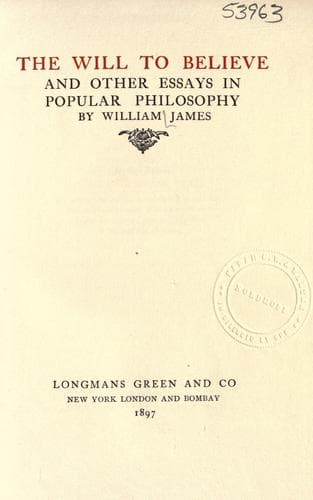
The Will to Believe, and Other Essays in Popular PhilosophyJames, William
Religion
The Will to Believe, and Other Essays in Popular Philosophy
James, William
Belief and doubt; Essays; Philosophy
The use of the maxim 'All determination is negation' is the fattest and
most full-blown application of the method of refusing to distinguish.
Taken in its vague confusion, it probably does more than anything else
to produce the sort of flicker and dazzle which are the first mental
conditions for the reception of Hegel's system. The word 'negation'
taken _simpliciter_ is treated as if it covered an indefinite number of
{287} _secundums_, culminating in the very peculiar one of
self-negation. Whence finally the conclusion is drawn that assertions
are universally self-contradictory. As this is an important matter, it
seems worth while to treat it a little minutely.
When I measure out a pint, say of milk, and so determine it, what do I
do? I virtually make two assertions regarding it,--it is this pint; it
is not those other gallons. One of these is an affirmation, the other
a negation. Both have a common subject; but the predicates being
mutually exclusive, the two assertions lie beside each other in endless
peace.
I may with propriety be said to make assertions more remote
still,--assertions of which those other gallons are the subject. As it
is not they, so are they not the pint which it is. The determination
"this is the pint" carries with it the negation,--"those are not the
pints." Here we have the same predicate; but the subjects are
exclusive of each other, so there is again endless peace. In both
couples of propositions negation and affirmation are _secundum aliud_:
this is _a_; this is n't not-_a_. This kind of negation involved in
determination cannot possibly be what Hegel wants for his purposes.
The table is not the chair, the fireplace is not the cupboard,--these
are literal expressions of the law of identity and contradiction, those
principles of the abstracting and separating understanding for which
Hegel has so sovereign a contempt, and which his logic is meant to
supersede.
And accordingly Hegelians pursue the subject further, saying there is
in every determination an element of real conflict. Do you not in
determining the milk to be this pint exclude it forever from the chance
of being those gallons, frustrate it from {288} expansion? And so do
you not equally exclude them from the being which it now maintains as
its own?
Assuredly if you had been hearing of a land flowing with milk and
honey, and had gone there with unlimited expectations of the rivers the
milk would fill; and if you found there was but this single pint in the
whole country,--the determination of the pint would exclude another
determination which your mind had previously made of the milk. There
would be a real conflict resulting in the victory of one side. The
rivers would be negated by the single pint being affirmed; and as
rivers and pint are affirmed of the same milk (first as supposed and
then as found), the contradiction would be complete.
Public-domain text, read in full here on John Shaqi.
Reviews
Reviews
No reviews yet
Be the first to share your thoughts on this work.
Elsewhere in the archive
Join the Discussion
Join the discussion
Sign in to leave a comment or review.
Sign InorCreate an account