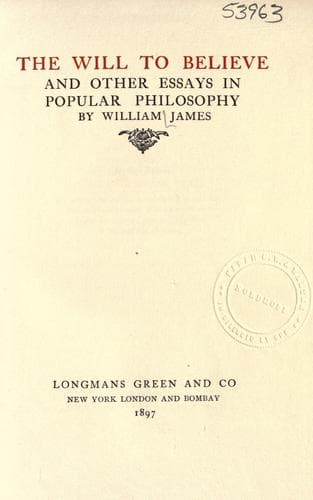
The Will to Believe, and Other Essays in Popular PhilosophyJames, William
Religion
The Will to Believe, and Other Essays in Popular Philosophy
James, William
Belief and doubt; Essays; Philosophy
But it is a contradiction that can never by any chance occur in real
nature or being. It can only occur between a false representation of a
being and the true idea of the being when actually cognized. The first
got into a place where it had no rights and had to be ousted. But in
_rerum naturâ_ things do not get into one another's logical places.
The gallons first spoken of never say, "We are the pint;" the pint
never says, "I am the gallons." It never tries to expand; and so there
is no chance for anything to exclude or negate it. It thus remains
affirmed absolutely.
Can it be believed in the teeth of these elementary truths that the
principle _determinatio negatio_ is held throughout Hegel to imply an
active contradiction, conflict, and exclusion? Do the horse-cars
jingling outside negate me writing in this room? Do I, reader, negate
you? Of course, if I say, "Reader, we are two, and therefore I am
two," I negate you, for I am actually thrusting a part into the seat of
the whole. {289} The orthodox logic expresses the fallacy by saying
the we is taken by me distributively instead of collectively; but as
long as I do not make this blunder, and am content with my part, we all
are safe. In _rerum naturâ_, parts remain parts. Can you imagine one
position in space trying to get into the place of another position and
having to be 'contradicted' by that other? Can you imagine your
thought of an object trying to dispossess the real object from its
being, and so being negated by it? The great, the sacred law of
partaking, the noiseless step of continuity, seems something that Hegel
cannot possibly understand. All or nothing is his one idea. For him
each point of space, of time, each feeling in the ego, each quality of
being, is clamoring, "I am the all,--there is nought else but me."
This clamor is its essence, which has to be negated in another act
which gives it its true determination. What there is of affirmative in
this determination is thus the mere residuum left from the negation by
others of the negation it originally applied to them.
But why talk of residuum? The Kilkenny cats of fable could leave a
residuum in the shape of their undevoured tails. But the Kilkenny cats
of existence as it appears in the pages of Hegel are all-devouring, and
leave no residuum. Such is the unexampled fury of their onslaught that
they get clean out of themselves and into each other, nay more, pass
right through each other, and then "return into themselves" ready for
another round, as insatiate, but as inconclusive, as the one that went
before.
Public-domain text, read in full here on John Shaqi.
Reviews
Reviews
No reviews yet
Be the first to share your thoughts on this work.
Elsewhere in the archive
Join the Discussion
Join the discussion
Sign in to leave a comment or review.
Sign InorCreate an account