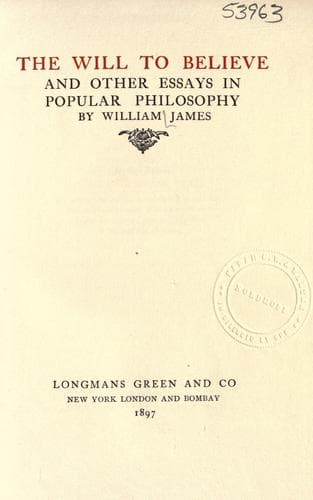
The Will to Believe, and Other Essays in Popular PhilosophyJames, William
Religion
The Will to Believe, and Other Essays in Popular Philosophy
James, William
Belief and doubt; Essays; Philosophy
If idealism be true, the great question that presents itself is whether
its truth involve the necessity of an infinite, unitary, and omniscient
consciousness, or whether a republic of semi-detached consciousnesses
will do,--consciousnesses united by a certain common fund of
representations, but each possessing a private store which the others
do not share. Either hypothesis is to me conceivable. But whether the
egos be one or many, the _nextness_ of representations to one another
within them is the principle of unification of the universe. To be
thus consciously next to some other representation is the condition to
which each representation must submit, under penalty of being excluded
from this universe, and like Lord Dundreary's bird 'flocking all
alone,' and forming a separate universe by itself. But this is only a
condition of which the representations _partake_; it leaves all their
other determinations undecided. To say, because representation _b_
cannot be in the same universe with _a_ without being _a's neighbor_;
that therefore _a_ possesses, involves, or necessitates _b_, hide and
hair, flesh and fell, all appurtenances and belongings,--is {292} only
the silly hegelian all-or-nothing insatiateness once more.
Hegel's own logic, with all the senseless hocus-pocus of its triads,
utterly fails to prove his position. The only evident compulsion which
representations exert upon one another is compulsion to submit to the
conditions of entrance into the same universe with them--the conditions
of continuity, of selfhood, space, and time--under penalty of being
excluded. But what this universe shall be is a matter of fact which we
cannot decide till we know what representations _have_ submitted to
these its sole conditions. The conditions themselves impose no further
requirements. In short, the notion that real contingency and ambiguity
may be features of the real world is a perfectly unimpeachable
hypothesis. Only in such a world can moral judgments have a claim to
be. For the bad is that which takes the place of something else which
possibly might have been where it now is, and the better is that which
absolutely might be where it absolutely is not. In the universe of
Hegel--the absolute block whose parts have no loose play, the pure
plethora of necessary being with the oxygen of possibility all
suffocated out of its lungs--there can be neither good nor bad, but one
dead level of mere fate.
Public-domain text, read in full here on John Shaqi.
Reviews
Reviews
No reviews yet
Be the first to share your thoughts on this work.
Elsewhere in the archive
Join the Discussion
Join the discussion
Sign in to leave a comment or review.
Sign InorCreate an account