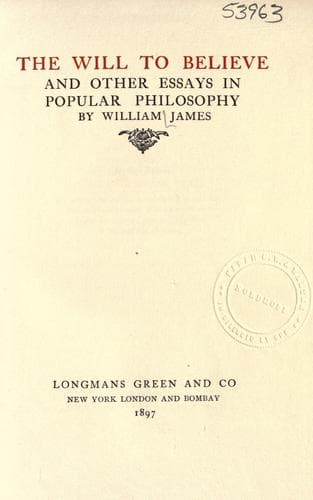
The Will to Believe, and Other Essays in Popular PhilosophyJames, William
Religion
The Will to Believe, and Other Essays in Popular Philosophy
James, William
Belief and doubt; Essays; Philosophy
If I characterized Hegel's own mood as _hubris_, the insolence of
excess, what shall I say of the mood he ascribes to being? Man makes
the gods in his {290} image; and Hegel, in daring to insult the
spotless _sôphrosune_ of space and time, the bound-respecters, in
branding as strife that law of sharing under whose sacred keeping, like
a strain of music, like an odor of incense (as Emerson says), the dance
of the atoms goes forward still, seems to me but to manifest his own
deformity.
This leads me to animadvert on an erroneous inference which hegelian
idealism makes from the form of the negative judgment. Every negation,
it says, must be an intellectual act. Even the most _naïf_ realism
will hardly pretend that the non-table as such exists _in se_ after the
same fashion as the table does. But table and non-table, since they
are given to our thought together, must be consubstantial. Try to make
the position or affirmation of the table as simple as you can, it is
also the negation of the non-table; and thus positive being itself
seems after all but a function of intelligence, like negation.
Idealism is proved, realism is unthinkable. Now I have not myself the
least objection to idealism,--an hypothesis which voluminous
considerations make plausible, and whose difficulties may be cleared
away any day by new discriminations or discoveries. But I object to
proving by these patent ready-made _à priori_ methods that which can
only be the fruit of a wide and patient induction. For the truth is
that our affirmations and negations do not stand on the same footing at
all, and are anything but consubstantial. An affirmation says
something about an objective existence. A negation says something
_about an affirmation_,--namely, that it is false. There are no
negative predicates or falsities in nature. Being makes no false
hypotheses that have {291} to be contradicted. The only denials she
can be in any way construed to perform are denials of our errors. This
shows plainly enough that denial must be of something mental, since the
thing denied is always a fiction. "The table is not the chair"
supposes the speaker to have been playing with the false notion that it
may have been the chair. But affirmation may perfectly well be of
something having no such necessary and constitutive relation to
thought. Whether it really is of such a thing is for harder
considerations to decide.
Public-domain text, read in full here on John Shaqi.
Reviews
Reviews
No reviews yet
Be the first to share your thoughts on this work.
Elsewhere in the archive
Join the Discussion
Join the discussion
Sign in to leave a comment or review.
Sign InorCreate an account