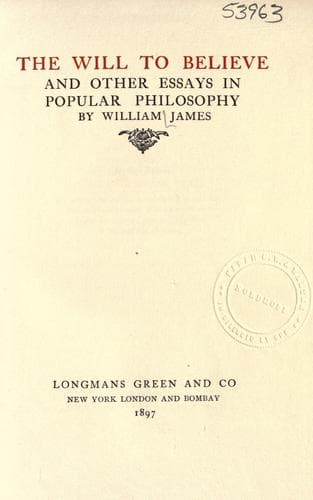
The Will to Believe, and Other Essays in Popular PhilosophyJames, William
Religion
The Will to Believe, and Other Essays in Popular Philosophy
James, William
Belief and doubt; Essays; Philosophy
According to the newspaper and drawing-room myth, soft-headedness and
idiotic credulity are the bond of sympathy in this Society, and general
wonder-sickness its dynamic principle. A glance at the membership
fails, however, to corroborate this view. The president is Prof. Henry
Sidgwick,[2] known by his other deeds as the most incorrigibly and
exasperatingly critical and sceptical mind in England. The hard-headed
Arthur Balfour is one vice-president, and the hard-headed Prof. J. P.
Langley, secretary of the Smithsonian Institution, is another. Such
men as Professor Lodge, the eminent English physicist, and Professor
Richet, the eminent French physiologist, are among the most active
contributors to the Society's Proceedings; and through the catalogue of
membership are sprinkled names honored throughout the world for their
scientific capacity. In fact, were I asked to point to a scientific
journal where hard-headedness and never-sleeping suspicion of sources
of error might be seen in their full bloom, {304} I think I should have
to fall back on the Proceedings of the Society for Psychical Research.
The common run of papers, say on physiological subjects, which one
finds in other professional organs, are apt to show a far lower level
of critical consciousness. Indeed, the rigorous canons of evidence
applied a few years ago to testimony in the case of certain 'mediums'
led to the secession from the Society of a number of spiritualists.
Messrs. Stainton Moses and A. R. Wallace, among others, thought that no
experiences based on mere eyesight could ever have a chance to be
admitted as true, if such an impossibly exacting standard of proof were
insisted on in every case.
The S. P. R., as I shall call it for convenience, was founded in 1882
by a number of gentlemen, foremost among whom seem to have been
Professors Sidgwick, W. F. Barrett, and Balfour Stewart, and Messrs. R.
H. Hutton, Hensleigh Wedgwood, Edmund Gurney, and F. W. H. Myers.
Their purpose was twofold,--first, to carry on systematic
experimentation with hypnotic subjects, mediums, clairvoyants, and
others; and, secondly, to collect evidence concerning apparitions,
haunted houses, and similar phenomena which are incidentally reported,
but which, from their fugitive character, admit of no deliberate
control. Professor Sidgwick, in his introductory address, insisted
that the divided state of public opinion on all these matters was a
scandal to science,--absolute disdain on _à priori_ grounds
characterizing what may be called professional opinion, while
indiscriminate credulity was too often found among those who pretended
to have a first-hand acquaintance with the facts.
Public-domain text, read in full here on John Shaqi.
Reviews
Reviews
No reviews yet
Be the first to share your thoughts on this work.
Elsewhere in the archive
Join the Discussion
Join the discussion
Sign in to leave a comment or review.
Sign InorCreate an account