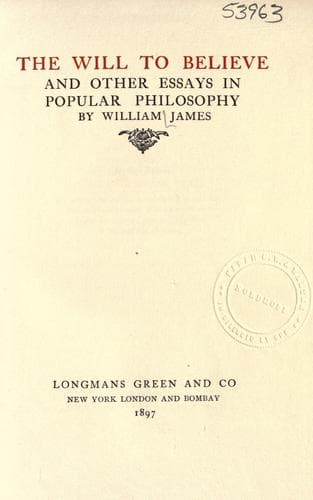
The Will to Believe, and Other Essays in Popular PhilosophyJames, William
Religion
The Will to Believe, and Other Essays in Popular Philosophy
James, William
Belief and doubt; Essays; Philosophy
Gurney shares, therefore, with Janet and Binet, the {311} credit of
demonstrating the simultaneous existence of two different strata of
consciousness, ignorant of each other, in the same person. The
'extra-consciousness,' as one may call it, can be kept on tap, as it
were, by the method of automatic writing. This discovery marks a new
era in experimental psychology, and it is impossible to overrate its
importance. But Gurney's greatest piece of work is his laborious
'Phantasms of the Living.' As an example of the drudgery stowed away
in the volumes, it may suffice to say that in looking up the proofs for
the alleged physical phenomena of witchcraft, Gurney reports a careful
search through two hundred and sixty books on the subject, with the
result of finding no first-hand evidence recorded in the trials except
the confessions of the victims themselves; and these, of course, are
presumptively due to either torture or hallucination. This statement,
made in an unobtrusive note, is only one instance of the care displayed
throughout the volumes. In the course of these, Gurney discusses about
seven hundred cases of apparitions which he collected. A large number
of these were 'veridical,' in the sense of coinciding with some
calamity happening to the person who appeared. Gurney's explanation is
that the mind of the person undergoing the calamity was at that moment
able to impress the mind of the percipient with an hallucination.
Apparitions, on this 'telepathic' theory, may be called 'objective'
facts, although they are not 'material' facts. In order to test the
likelihood of such veridical hallucinations being due to mere chance,
Gurney instituted the 'census of hallucinations,' which has been
continued with the result of obtaining answers from over twenty-five
thousand persons, asked {312} at random in different countries whether,
when in good health and awake, they had ever heard a voice, seen a
form, or felt a touch which no material presence could account for.
The result seems to be, roughly speaking, that in England about one
adult in ten has had such an experience at least once in his life, and
that of the experiences themselves a large number coincide with some
distant event. The question is, Is the frequency of these latter cases
too great to be deemed fortuitous, and must we suppose an occult
connection between the two events? Mr. and Mrs. Sidgwick have worked
out this problem on the basis of the English returns, seventeen
thousand in number, with a care and thoroughness that leave nothing to
be desired. Their conclusion is that the cases where the apparition of
a person is seen on the day of his death are four hundred and forty
times too numerous to be ascribed to chance. The reasoning employed to
calculate this number is simple enough. If there be only a fortuitous
connection between the death of an individual and the occurrence of his
apparition to some one at a distance, the death is no more likely to
Public-domain text, read in full here on John Shaqi.
Reviews
Reviews
No reviews yet
Be the first to share your thoughts on this work.
Elsewhere in the archive
Join the Discussion
Join the discussion
Sign in to leave a comment or review.
Sign InorCreate an account