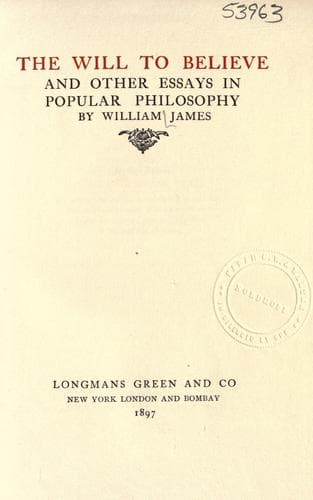
The Will to Believe, and Other Essays in Popular PhilosophyJames, William
Religion
The Will to Believe, and Other Essays in Popular Philosophy
James, William
Belief and doubt; Essays; Philosophy
fall on the same day as the apparition than it is to occur on the same
day with any other event in nature. But the chance-probability that
any individual's death will fall on any given day marked in advance by
some other event is just equal to the chance-probability that the
individual will die at all on any specified day; and the national
death-rate gives that probability as one in nineteen thousand. If,
then, when the death of a person coincides with an apparition of the
same person, the coincidence be merely fortuitous, it ought not to
occur oftener than once in nineteen thousand cases. As a matter of
fact, {313} however, it does occur (according to the census) once in
forty-three cases, a number (as aforesaid) four hundred and forty times
too great. The American census, of some seven thousand answers, gives
a remarkably similar result. Against this conclusion the only rational
answer that I can see is that the data are still too few; that the net
was not cast wide enough; and that we need, to get fair averages, far
more than twenty-four thousand answers to the census question. This
may, of course, be true, though it seems exceedingly unlikely; and in
our own twenty-four thousand answers veridical cases may possibly have
heaped themselves unduly.
The next topic worth mentioning in the Proceedings is the discussion of
the physical phenomena of mediumship (slate-writing, furniture-moving,
and so forth) by Mrs. Sidgwick, Mr. Hodgson, and 'Mr. Davey.' This, so
far as it goes, is destructive of the claims of all the mediums
examined. 'Mr. Davey' himself produced fraudulent slate-writing of the
highest order, while Mr. Hodgson, a 'sitter' in his confidence,
reviewed the written reports of the series of his other sitters,--all
of them intelligent persons,--and showed that in every case they failed
to see the essential features of what was done before their eyes. This
Davey-Hodgson contribution is probably the most damaging document
concerning eye-witnesses' evidence that has ever been produced.
Another substantial bit of work based on personal observation is Mr.
Hodgson's report on Madame Blavatsky's claims to physical mediumship.
This is adverse to the lady's pretensions; and although some of Madame
Blavatsky's friends make light of it, it is a stroke from which her
reputation will not recover.
{314}
Physical mediumship in all its phases has fared hard in the
Proceedings. The latest case reported on is that of the famous Eusapia
Paladino, who being detected in fraud at Cambridge, after a brilliant
career of success on the continent, has, according to the draconian
rules of method which govern the Society, been ruled out from a further
hearing. The case of Stainton Moses, on the other hand, concerning
which Mr. Myers has brought out a mass of unpublished testimony, seems
to escape from the universal condemnation, and appears to force upon us
what Mr. Andrew Lang calls the choice between a moral and a physical
miracle.
Public-domain text, read in full here on John Shaqi.
Reviews
Reviews
No reviews yet
Be the first to share your thoughts on this work.
Elsewhere in the archive
Join the Discussion
Join the discussion
Sign in to leave a comment or review.
Sign InorCreate an account