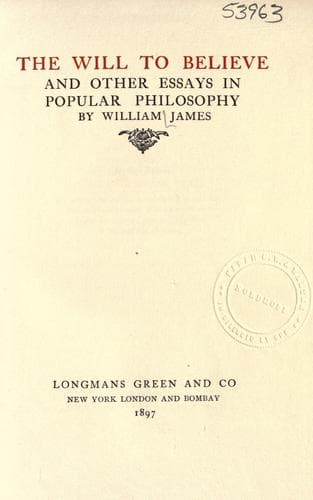
The Will to Believe, and Other Essays in Popular PhilosophyJames, William
Religion
The Will to Believe, and Other Essays in Popular Philosophy
James, William
Belief and doubt; Essays; Philosophy
"Each of us is in reality an abiding psychical entity far more
extensive than he knows,--an individuality which can never express
itself completely through any corporeal manifestation. The self
manifests itself through the organism; but there is always some part of
the self unmanifested, and always, as it seems, some power of organic
expression in abeyance or reserve."
The ordinary consciousness Mr. Myers likens to the visible part of the
solar spectrum; the total consciousness is like that spectrum prolonged
by the inclusion of the ultra-red and ultra-violet rays. In the
psychic spectrum the 'ultra' parts may embrace a far wider range, both
of physiological and of psychical activity, than is open to our
ordinary consciousness and memory. At the lower end we have the
_physiological_ extension, mind-cures, 'stigmatization' of ecstatics,
etc.; in the upper, the hyper-normal cognitions of the medium-trance.
Whatever the judgment of the future may be on Mr. Myers's speculations,
the credit will always remain to them of being the first attempt in any
language to consider the phenomena of hallucination, hypnotism,
automatism, double personality, and mediumship as connected parts of
one whole subject. All constructions in this field must be
provisional, and it is as something provisional that Mr. Myers offers
us his formulations. But, thanks to him, we begin to see for the first
time what a vast interlocked and graded system these phenomena, from
the rudest motor-automatisms to the most startling sensory-apparition,
form. Quite apart from Mr. Myers's conclusions, his methodical
treatment of them by classes and series is the first great step toward
overcoming the distaste of orthodox science to look at them at all.
{317}
One's reaction on hearsay testimony is always determined by one's own
experience. Most men who have once convinced themselves, by what seems
to them a careful examination, that any one species of the supernatural
exists, begin to relax their vigilance as to evidence, and throw the
doors of their minds more or less wide open to the supernatural along
its whole extent. To a mind that has thus made its _salto mortale_,
the minute work over insignificant cases and quiddling discussion of
'evidential values,' of which the Society's reports are full, seems
insufferably tedious. And it is so; few species of literature are more
truly dull than reports of phantasms. Taken simply by themselves, as
separate facts to stare at, they appear so devoid of meaning and sweep,
that, even were they certainly true, one would be tempted to leave them
out of one's universe for being so idiotic. Every other sort of fact
has some context and continuity with the rest of nature. These alone
are contextless and discontinuous.
Public-domain text, read in full here on John Shaqi.
Reviews
Reviews
No reviews yet
Be the first to share your thoughts on this work.
Elsewhere in the archive
Join the Discussion
Join the discussion
Sign in to leave a comment or review.
Sign InorCreate an account