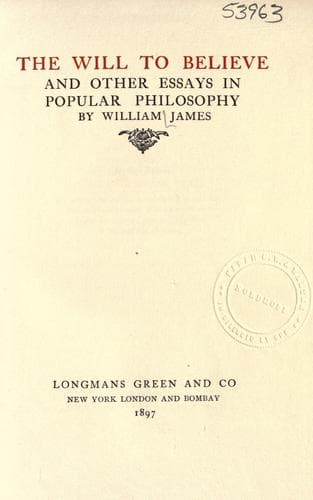
The Will to Believe, and Other Essays in Popular PhilosophyJames, William
Religion
The Will to Believe, and Other Essays in Popular Philosophy
James, William
Belief and doubt; Essays; Philosophy
Hence I think that the sort of loathing--no milder word will do--which
the very words 'psychical research' and 'psychical researcher' awaken
in so many honest scientific breasts is not only natural, but in a
sense praiseworthy. A man who is unable himself to conceive of any
_orbit_ for these mental meteors can only suppose that Messrs. Gurney,
Myers, & Co.'s mood in dealing with them must be that of silly
marvelling at so many detached prodigies. And such prodigies! So
science simply falls back on her general _non-possumus_; and most of
the would-be critics of the Proceedings have been contented to oppose
to the phenomena recorded the simple presumption that in some way or
other the reports _must_ be {318} fallacious,--for so far as the order
of nature has been subjected to really scientific scrutiny, it always
has been proved to run the other way. But the oftener one is forced to
reject an alleged sort of fact by the use of this mere presumption, the
weaker does the presumption itself get to be; and one might in course
of time use up one's presumptive privileges in this way, even though
one started (as our anti-telepathists do) with as good a case as the
great induction of psychology that all our knowledge comes by the use
of our eyes and ears and other senses. And we must remember also that
this undermining of the strength of a presumption by reiterated report
of facts to the contrary does not logically require that the facts in
question should all be well proved. A lot of rumors in the air against
a business man's credit, though they might all be vague, and no one of
them amount to proof that he is unsound, would certainly weaken the
_presumption_ of his soundness. And all the more would they have this
effect if they formed what Gurney called a fagot and not a chain,--that
is, if they were independent of one another, and came from different
quarters. Now, the evidence for telepathy, weak and strong, taken just
as it comes, forms a fagot and not a chain. No one item cites the
content of another item as part of its own proof. But taken together
the items have a certain general consistency; there is a method in
their madness, so to speak. So each of them adds presumptive value to
the lot; and cumulatively, as no candid mind can fail to see, they
subtract presumptive force from the orthodox belief that there can be
nothing in any one's intellect that has not come in through ordinary
experiences of sense.
Public-domain text, read in full here on John Shaqi.
Reviews
Reviews
No reviews yet
Be the first to share your thoughts on this work.
Elsewhere in the archive
Join the Discussion
Join the discussion
Sign in to leave a comment or review.
Sign InorCreate an account