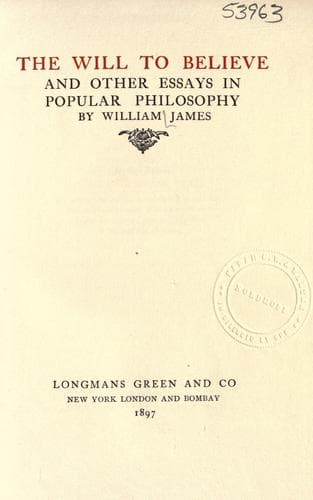
The Will to Believe, and Other Essays in Popular Philosophy — John Shaqi
The Will to Believe, and Other Essays in Popular PhilosophyJames, William
Religion
The Will to Believe, and Other Essays in Popular Philosophy
James, William
Belief and doubt; Essays; Philosophy
But now, it will be said, these are all childish human cases, and have
nothing to do with great cosmical matters, like the question of
religious faith. Let us then pass on to that. Religions differ so
much in their accidents that in discussing the religious question we
must make it very generic and broad. What then do we now mean by the
religious hypothesis? Science says things are; morality says some
things are better than other things; and religion says essentially two
things.
First, she says that the best things are the more eternal things, the
overlapping things, the things in the universe that throw the last
stone, so to speak, and say the final word. "Perfection is
eternal,"--this phrase of Charles Secrétan seems a good way of putting
this first affirmation of religion, an affirmation which obviously
cannot yet be verified scientifically at all.
{26}
The second affirmation of religion is that we are better off even now
if we believe her first affirmation to be true.
Now, let us consider what the logical elements of this situation are
_in case the religious hypothesis in both its branches be really true_.
(Of course, we must admit that possibility at the outset. If we are to
discuss the question at all, it must involve a living option. If for
any of you religion be a hypothesis that cannot, by any living
possibility be true, then you need go no farther. I speak to the
'saving remnant' alone.) So proceeding, we see, first, that religion
offers itself as a _momentous_ option. We are supposed to gain, even
now, by our belief, and to lose by our non-belief, a certain vital
good. Secondly, religion is a _forced_ option, so far as that good
goes. We cannot escape the issue by remaining sceptical and waiting
for more light, because, although we do avoid error in that way _if
religion be untrue_, we lose the good, _if it be true_, just as
certainly as if we positively chose to disbelieve. It is as if a man
should hesitate indefinitely to ask a certain woman to marry him
because he was not perfectly sure that she would prove an angel after
he brought her home. Would he not cut himself off from that particular
angel-possibility as decisively as if he went and married some one
else? Scepticism, then, is not avoidance of option; it is option of a
certain particular kind of risk. _Better risk loss of truth than
chance of error_,--that is your faith-vetoer's exact position. He is
actively playing his stake as much as the believer is; he is backing
the field against the religious hypothesis, just as the believer is
backing the religious hypothesis against the field. To preach
scepticism to us as a duty until {27} 'sufficient evidence' for
religion be found, is tantamount therefore to telling us, when in
presence of the religious hypothesis, that to yield to our fear of its
being error is wiser and better than to yield to our hope that it may
be true. It is not intellect against all passions, then; it is only
Public-domain text, read in full here on John Shaqi.
Reviews
Reviews
No reviews yet
Be the first to share your thoughts on this work.
Join the Discussion
Join the discussion
Sign in to leave a comment or review.
Sign InorCreate an account