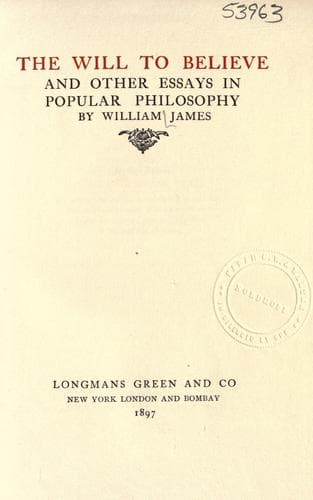
The Will to Believe, and Other Essays in Popular Philosophy — John Shaqi
The Will to Believe, and Other Essays in Popular PhilosophyJames, William
Religion
The Will to Believe, and Other Essays in Popular Philosophy
James, William
Belief and doubt; Essays; Philosophy
keep my willing nature out of the game. I cannot do so for this plain
reason, that _a rule of thinking which would absolutely prevent me from
acknowledging certain kinds of truth if those kinds of truth were
really there, would be an irrational rule_. That for me {29} is the
long and short of the formal logic of the situation, no matter what the
kinds of truth might materially be.
I confess I do not see how this logic can be escaped. But sad
experience makes me fear that some of you may still shrink from
radically saying with me, _in abstracto_, that we have the right to
believe at our own risk any hypothesis that is live enough to tempt our
will. I suspect, however, that if this is so, it is because you have
got away from the abstract logical point of view altogether, and are
thinking (perhaps without realizing it) of some particular religious
hypothesis which for you is dead. The freedom to 'believe what we
will' you apply to the case of some patent superstition; and the faith
you think of is the faith defined by the schoolboy when he said, "Faith
is when you believe something that you know ain't true." I can only
repeat that this is misapprehension. _In concreto_, the freedom to
believe can only cover living options which the intellect of the
individual cannot by itself resolve; and living options never seem
absurdities to him who has them to consider. When I look at the
religious question as it really puts itself to concrete men, and when I
think of all the possibilities which both practically and theoretically
it involves, then this command that we shall put a stopper on our
heart, instincts, and courage, and wait--acting of course meanwhile
more or less as if religion were _not_ true[4]--till {30} doomsday, or
till such time as our intellect and senses working together may have
raked in evidence enough,--this command, I say, seems to me the
queerest idol ever manufactured in the philosophic cave. Were we
scholastic absolutists, there might be more excuse. If we had an
infallible intellect with its objective certitudes, we might feel
ourselves disloyal to such a perfect organ of knowledge in not trusting
to it exclusively, in not waiting for its releasing word. But if we
are empiricists, if we believe that no bell in us tolls to let us know
for certain when truth is in our grasp, then it seems a piece of idle
fantasticality to preach so solemnly our duty of waiting for the bell.
Indeed we _may_ wait if we will,--I hope you do not think that I am
denying that,--but if we do so, we do so at our peril as much as if we
believed. In either case we _act_, taking our life in our hands. No
one of us ought to issue vetoes to the other, nor should we bandy words
of abuse. We ought, on the contrary, delicately and profoundly to
respect one another's mental freedom: then only shall we bring about
the intellectual republic; then only shall we have that spirit of inner
tolerance without which all our outer tolerance is soulless, and which
Public-domain text, read in full here on John Shaqi.
Reviews
Reviews
No reviews yet
Be the first to share your thoughts on this work.
Join the Discussion
Join the discussion
Sign in to leave a comment or review.
Sign InorCreate an account