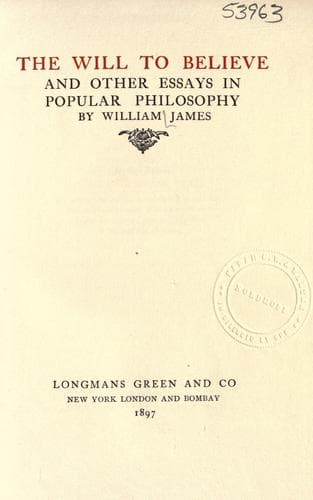
The Will to Believe, and Other Essays in Popular Philosophy — John Shaqi
The Will to Believe, and Other Essays in Popular PhilosophyJames, William
Religion
The Will to Believe, and Other Essays in Popular Philosophy
James, William
Belief and doubt; Essays; Philosophy
That is why I call pessimism an essentially religious disease. The
nightmare view of life has plenty of organic sources; but its great
reflective source has at all times been the contradiction between the
phenomena of nature and the craving of the heart to believe that behind
nature there is a spirit whose expression nature is. What philosophers
call 'natural theology' has been one way of appeasing this craving;
that poetry of nature in which our English literature is so rich has
been another way. Now, suppose a mind of the latter of our two
classes, whose imagination is pent in consequently, and who takes its
{41} facts 'hard;' suppose it, moreover, to feel strongly the craving
for communion, and yet to realize how desperately difficult it is to
construe the scientific order of nature either theologically or
poetically,--and what result can there be but inner discord and
contradiction? Now, this inner discord (merely as discord) can be
relieved in either of two ways: The longing to read the facts
religiously may cease, and leave the bare facts by themselves; or,
supplementary facts may be discovered or believed-in, which permit the
religious reading to go on. These two ways of relief are the two
stages of recovery, the two levels of escape from pessimism, to which I
made allusion a moment ago, and which the sequel will, I trust, make
more clear.
III.
Starting then with nature, we naturally tend, if we have the religious
craving, to say with Marcus Aurelius, "O Universe! what thou wishest I
wish." Our sacred books and traditions tell us of one God who made
heaven and earth, and, looking on them, saw that they were good. Yet,
on more intimate acquaintance, the visible surfaces of heaven and earth
refuse to be brought by us into any intelligible unity at all. Every
phenomenon that we would praise there exists cheek by jowl with some
contrary phenomenon that cancels all its religious effect upon the
mind. Beauty and hideousness, love and cruelty, life and death keep
house together in indissoluble partnership; and there gradually steals
over us, instead of the old warm notion of a man-loving Deity, that of
an awful power that neither hates nor loves, but rolls all things {42}
together meaninglessly to a common doom. This is an uncanny, a
sinister, a nightmare view of life, and its peculiar _unheimlichkeit_,
or poisonousness, lies expressly in our holding two things together
which cannot possibly agree,--in our clinging, on the one hand, to the
demand that there shall be a living spirit of the whole; and, on the
other, to the belief that the course of nature must be such a spirit's
adequate manifestation and expression. It is in the contradiction
between the supposed being of a spirit that encompasses and owns us,
and with which we ought to have some communion, and the character of
such a spirit as revealed by the visible world's course, that this
particular death-in-life paradox and this melancholy-breeding puzzle
Public-domain text, read in full here on John Shaqi.
Reviews
Reviews
No reviews yet
Be the first to share your thoughts on this work.
Join the Discussion
Join the discussion
Sign in to leave a comment or review.
Sign InorCreate an account