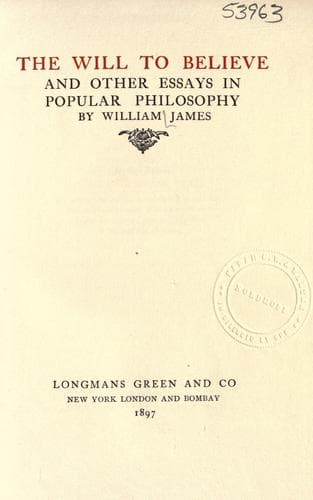
The Will to Believe, and Other Essays in Popular PhilosophyJames, William
Religion
The Will to Believe, and Other Essays in Popular Philosophy
James, William
Belief and doubt; Essays; Philosophy
After all, though, you will say, Why such an ado about a matter
concerning which, however we may theoretically differ, we all
practically agree? In this age of toleration, no scientist will ever
try actively to interfere with our religious faith, provided we enjoy
it quietly with our friends and do not make a public nuisance of it in
the market-place. But it is just on this matter of the market-place
that I think the utility of such essays as mine may turn. If {xii}
religious hypotheses about the universe be in order at all, then the
active faiths of individuals in them, freely expressing themselves in
life, are the experimental tests by which they are verified, and the
only means by which their truth or falsehood can be wrought out. The
truest scientific hypothesis is that which, as we say, 'works' best;
and it can be no otherwise with religious hypotheses. Religious
history proves that one hypothesis after another has worked ill, has
crumbled at contact with a widening knowledge of the world, and has
lapsed from the minds of men. Some articles of faith, however, have
maintained themselves through every vicissitude, and possess even more
vitality to-day than ever before: it is for the 'science of religions'
to tell us just which hypotheses these are. Meanwhile the freest
competition of the various faiths with one another, and their openest
application to life by their several champions, are the most favorable
conditions under which the survival of the fittest can proceed. They
ought therefore not to lie hid each under its bushel, indulged-in
quietly with friends. They ought to live in publicity, vying with each
other; and it seems to me that (the régime of tolerance once granted,
and a fair field shown) the scientist has nothing to fear for his own
interests from the liveliest possible state of fermentation in the
religious world of his time. Those faiths will best stand the test
which adopt also his hypotheses, and make them integral elements of
their own. He should welcome therefore every species of religious
agitation and discussion, so long as he is willing to allow that some
religious hypothesis _may_ be {xiii} true. Of course there are plenty
of scientists who would deny that dogmatically, maintaining that
science has already ruled all possible religious hypotheses out of
court. Such scientists ought, I agree, to aim at imposing privacy on
religious faiths, the public manifestation of which could only be a
nuisance in their eyes. With all such scientists, as well as with
their allies outside of science, my quarrel openly lies; and I hope
that my book may do something to persuade the reader of their crudity,
and range him on my side. Religious fermentation is always a symptom
of the intellectual vigor of a society; and it is only when they forget
that they are hypotheses and put on rationalistic and authoritative
pretensions, that our faiths do harm. The most interesting and
Public-domain text, read in full here on John Shaqi.
Reviews
Reviews
No reviews yet
Be the first to share your thoughts on this work.
Join the Discussion
Join the discussion
Sign in to leave a comment or review.
Sign InorCreate an account