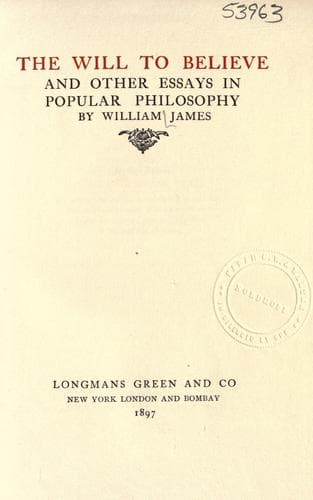
The Will to Believe, and Other Essays in Popular PhilosophyJames, William
Religion
The Will to Believe, and Other Essays in Popular Philosophy
James, William
Belief and doubt; Essays; Philosophy
When, for example, we think that we have rationally explained the
connection of the facts _A_ and _B_ by classing both under their common
attribute _x_, it is obvious that we have really explained only so much
of these items as _is x_. To explain the connection of choke-damp and
suffocation by the lack of oxygen is {68} to leave untouched all the
other peculiarities both of choke-damp and of suffocation,--such as
convulsions and agony on the one hand, density and explosibility on the
other. In a word, so far as _A_ and _B_ contain _l_, _m_, _n_, and
_o_, _p_, _q,_ respectively, in addition to _x_, they are not explained
by _x_. Each additional particularity makes its distinct appeal. A
single explanation of a fact only explains it from a single point of
view. The entire fact is not accounted for until each and all of its
characters have been classed with their likes elsewhere. To apply this
now to the case of the universe, we see that the explanation of the
world by molecular movements explains it only so far as it actually
_is_ such movements. To invoke the 'Unknowable' explains only so much
as is unknowable, 'Thought' only so much as is thought, 'God' only so
much as is God. _Which_ thought? _Which_ God?--are questions that
have to be answered by bringing in again the residual data from which
the general term was abstracted. All those data that cannot be
analytically identified with the attribute invoked as universal
principle, remain as independent kinds or natures, associated
empirically with the said attribute but devoid of rational kinship with
it.
Hence the unsatisfactoriness of all our speculations. On the one hand,
so far as they retain any multiplicity in their terms, they fail to get
us out of the empirical sand-heap world; on the other, so far as they
eliminate multiplicity the practical man despises their empty
barrenness. The most they can say is that the elements of the world
are such and such, and that each is identical with itself wherever
found; but the question Where is it found? the practical man is left to
answer by his own wit. Which, of all the {69} essences, shall here and
now be held the essence of this concrete thing, the fundamental
philosophy never attempts to decide. We are thus led to the conclusion
that the simple classification of things is, on the one hand, the best
possible theoretic philosophy, but is, on the other, a most miserable
and inadequate substitute for the fulness of the truth. It is a
monstrous abridgment of life, which, like all abridgments is got by the
absolute loss and casting out of real matter. This is why so few human
beings truly care for philosophy. The particular determinations which
she ignores are the real matter exciting needs, quite as potent and
authoritative as hers. What does the moral enthusiast care for
philosophical ethics? Why does the _AEsthetik_ of every German
philosopher appear to the artist an abomination of desolation?
Public-domain text, read in full here on John Shaqi.
Reviews
Reviews
No reviews yet
Be the first to share your thoughts on this work.
Join the Discussion
Join the discussion
Sign in to leave a comment or review.
Sign InorCreate an account