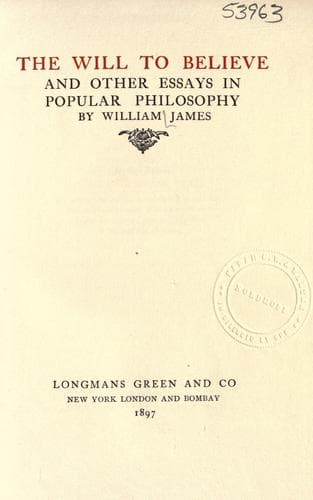
The Will to Believe, and Other Essays in Popular PhilosophyJames, William
Religion
The Will to Believe, and Other Essays in Popular Philosophy
James, William
Belief and doubt; Essays; Philosophy
Temperamental Optimism and Pessimism, 33. How reconcile
with life one bent on suicide? 38. Religious melancholy and its
cure, 39. Decay of Natural Theology, 43. Instinctive antidotes
to pessimism, 46. Religion involves belief in an unseen
extension of the world, 51. Scientific positivism, 52. Doubt
actuates conduct as much as belief does, 54. To deny certain
faiths is logically absurd, for they make their objects true, 56.
Conclusion, 6l.
THE SENTIMENT OF RATIONALITY . . . . . . . . . . . . . . . . . . 63
Rationality means fluent thinking, 63. Simplification, 65.
Clearness, 66. Their antagonism, 66. Inadequacy of the
abstract, 68. The thought of nonentity, 71. Mysticism, 74. Pure
theory cannot banish wonder, 75. The passage to practice may
restore the feeling of rationality, 75. Familiarity and
expectancy, 76. 'Substance,' 80. A rational world must appear
{xvi}
congruous with our powers, 82. But these differ from man to
man, 88. Faith is one of them, 90. Inseparable from doubt, 95.
May verify itself, 96. Its rôle in ethics, 98. Optimism and
pessimism, 101. Is this a moral universe?--what does the problem
mean? 103. Anaesthesia _versus_ energy, 107. Active assumption
necessary, 107. Conclusion, 110.
REFLEX ACTION AND THEISM . . . . . . . . . . . . . . . . . . . . 111
Prestige of Physiology, 112. Plan of neural action, 113. God
the mind's adequate object, 116. Contrast between world as
perceived and as conceived, 118. God, 120. The mind's three
departments, 123. Science due to a subjective demand, 129.
Theism a mean between two extremes, 134. Gnosticism, 137.
No intellection except for practical ends, 140. Conclusion, 142.
THE DILEMMA OF DETERMINISM . . . . . . . . . . . . . . . . . . . 145
Philosophies seek a rational world, 146. Determinism and
Indeterminism defined, 149. Both are postulates of rationality,
152. Objections to chance considered, 153. Determinism
involves pessimism, 159. Escape _via_ Subjectivism, 164.
Subjectivism leads to corruption, 170. A world with chance in
it is morally the less irrational alternative, 176. Chance not
incompatible with an ultimate Providence, 180.
THE MORAL PHILOSOPHER AND THE MORAL LIFE . . . . . . . . . . . . 184
The moral philosopher postulates a unified system, 185.
Origin of moral judgments, 185. Goods and ills are created by
judgment?, 189. Obligations are created by demands, 192. The
conflict of ideals, 198. Its solution, 205. Impossibility of an
abstract system of Ethics, 208. The easy-going and the
strenuous mood, 211. Connection between Ethics and Religion, 212.
GREAT MEN AND THEIR ENVIRONMENT . . . . . . . . . . . . . . . . 216
Public-domain text, read in full here on John Shaqi.
Reviews
Reviews
No reviews yet
Be the first to share your thoughts on this work.
Join the Discussion
Join the discussion
Sign in to leave a comment or review.
Sign InorCreate an account