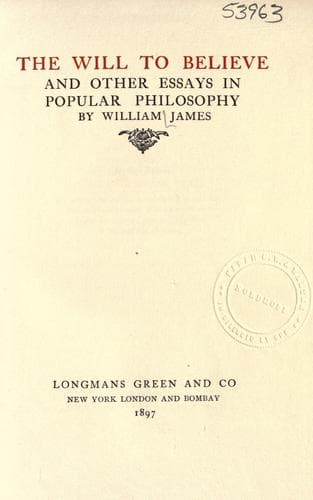
The Will to Believe, and Other Essays in Popular PhilosophyJames, William
Religion
The Will to Believe, and Other Essays in Popular Philosophy
James, William
Belief and doubt; Essays; Philosophy
Anti-substantialist writers strangely overlook this function in the
doctrine of substance; "If there be such a _substratum_," says Mill,
"suppose it at this instant miraculously annihilated, and let the
sensations continue to occur in the same order, and how would the
_substratum_ be missed? By what signs should we be able to discover
that its existence had terminated? Should we not have as much reason
to believe that it still existed as we now have? And if we should not
then be warranted in believing it, how can we be so now?" Truly
enough, if we have {81} already securely bagged our facts in a certain
order, we can dispense with any further warrant for that order. But
with regard to the facts yet to come the case is far different. It
does not follow that if substance may be dropped from our conception of
the irrecoverably past, it need be an equally empty complication to our
notions of the future. Even if it were true that, for aught we know to
the contrary, the substance might develop at any moment a wholly new
set of attributes, the mere logical form of referring things to a
substance would still (whether rightly or wrongly) remain accompanied
by a feeling of rest and future confidence. In spite of the acutest
nihilistic criticism, men will therefore always have a liking for any
philosophy which explains things _per substantiam_.
A very natural reaction against the theosophizing conceit and
hide-bound confidence in the upshot of things, which vulgarly
optimistic minds display, has formed one factor of the scepticism of
empiricists, who never cease to remind us of the reservoir of
possibilities alien to our habitual experience which the cosmos may
contain, and which, for any warrant we have to the contrary, may turn
it inside out to-morrow. Agnostic substantialism like that of Mr.
Spencer, whose Unknowable is not merely the unfathomable but the
absolute-irrational, on which, if consistently represented in thought,
it is of course impossible to count, performs the same function of
rebuking a certain stagnancy and smugness in the manner in which the
ordinary philistine feels his security. But considered as anything
else than as reactions against an opposite excess, these philosophies
of uncertainty cannot be acceptable; the general mind will fail to {82}
come to rest in their presence, and will seek for solutions of a more
reassuring kind.
We may then, I think, with perfect confidence lay down as a first point
gained in our inquiry, that a prime factor in the philosophic craving
is the desire to have expectancy defined; and that no philosophy will
definitively triumph which in an emphatic manner denies the possibility
of gratifying this need.
Public-domain text, read in full here on John Shaqi.
Reviews
Reviews
No reviews yet
Be the first to share your thoughts on this work.
Elsewhere in the archive
Join the Discussion
Join the discussion
Sign in to leave a comment or review.
Sign InorCreate an account