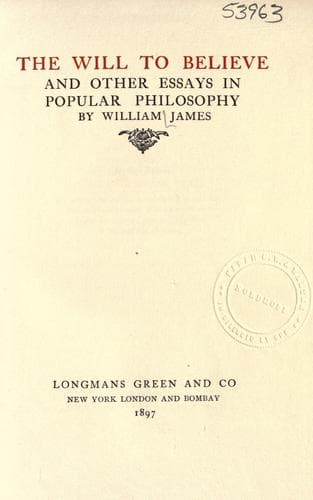
The Will to Believe, and Other Essays in Popular PhilosophyJames, William
Religion
The Will to Believe, and Other Essays in Popular Philosophy
James, William
Belief and doubt; Essays; Philosophy
We pass with this to the next great division of our topic. It is not
sufficient for our satisfaction merely to know the future as
determined, for it may be determined in either of many ways, agreeable
or disagreeable. For a philosophy to succeed on a universal scale it
must define the future _congruously with our spontaneous powers_. A
philosophy may be unimpeachable in other respects, but either of two
defects will be fatal to its universal acceptance. First, its ultimate
principle must not be one that essentially baffles and disappoints our
dearest desires and most cherished powers. A pessimistic principle
like Schopenhauer's incurably vicious Will-substance, or Hartmann's
wicked jack-of-all-trades the Unconscious, will perpetually call forth
essays at other philosophies. Incompatibility of the future with their
desires and active tendencies is, in fact, to most men a source of more
fixed disquietude than uncertainty itself. Witness the attempts to
overcome the 'problem of evil,' the 'mystery of pain.' There is no
'problem of good.'
But a second and worse defect in a philosophy than that of
contradicting our active propensities is to give them no object
whatever to press against. A philosophy whose principle is so
incommensurate with our most intimate powers as to deny them all {83}
relevancy in universal affairs, as to annihilate their motives at one
blow, will be even more unpopular than pessimism. Better face the
enemy than the eternal Void! This is why materialism will always fail
of universal adoption, however well it may fuse things into an
atomistic unity, however clearly it may prophesy the future eternity.
For materialism denies reality to the objects of almost all the
impulses which we most cherish. The real _meaning_ of the impulses, it
says, is something which has no emotional interest for us whatever.
Now, what is called 'extradition' is quite as characteristic of our
emotions as of our senses: both point to an object as the cause of the
present feeling. What an intensely objective reference lies in fear!
In like manner an enraptured man and a dreary-feeling man are not
simply aware of their subjective states; if they were, the force of
their feelings would all evaporate. Both believe there is outward
cause why they should feel as they do: either, "It is a glad world! how
good life is!" or, "What a loathsome tedium is existence!" Any
philosophy which annihilates the validity of the reference by
explaining away its objects or translating them into terms of no
emotional pertinency, leaves the mind with little to care or act for.
This is the opposite condition from that of nightmare, but when acutely
brought home to consciousness it produces a kindred horror. In
nightmare we have motives to act, but no power; here we have powers,
but no motives. A nameless _unheimlichkeit_ comes over us at the
thought of there being nothing eternal in our final purposes, in the
Public-domain text, read in full here on John Shaqi.
Reviews
Reviews
No reviews yet
Be the first to share your thoughts on this work.
Elsewhere in the archive
Join the Discussion
Join the discussion
Sign in to leave a comment or review.
Sign InorCreate an account