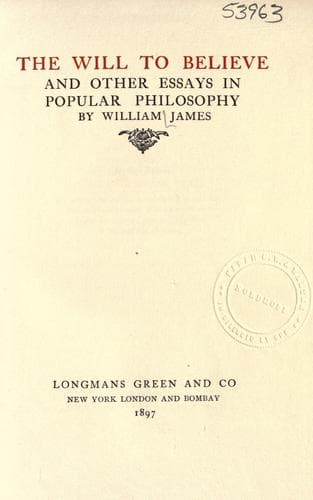
The Will to Believe, and Other Essays in Popular PhilosophyJames, William
Religion
The Will to Believe, and Other Essays in Popular Philosophy
James, William
Belief and doubt; Essays; Philosophy
Helmholtz's immortal works on the eye and ear are to a great extent
little more than a commentary on the law that practical utility wholly
determines which parts of our sensations we shall be aware of, and
which parts we shall ignore. We notice or discriminate an ingredient
of sense only so far as we depend upon it to modify our actions. We
_comprehend_ a thing when we synthetize it by identity with another
thing. But the other great department of our understanding,
_acquaintance_ (the two departments being recognized in all languages
by the antithesis of such words as _wissen_ and _kennen_; _scire_ and
_noscere_, etc.), what is that also but a synthesis,--a synthesis of a
passive perception with a certain tendency to reaction? We are
acquainted with a thing as soon as we have learned how to behave
towards it, or how to meet the behavior which we expect from it. Up to
that point it is still 'strange' to us.
{86}
If there be anything at all in this view, it follows that however
vaguely a philosopher may define the ultimate universal datum, he
cannot be said to leave it unknown to us so long as he in the slightest
degree pretends that our emotional or active attitude toward it should
be of one sort rather than another. He who says "life is real, life is
earnest," however much he may speak of the fundamental mysteriousness
of things, gives a distinct definition to that mysteriousness by
ascribing to it the right to claim from us the particular mood called
seriousness,--which means the willingness to live with energy, though
energy bring pain. The same is true of him who says that all is
vanity. For indefinable as the predicate 'vanity' may be _in se_, it
is clearly something that permits anaesthesia, mere escape from
suffering, to be our rule of life. There can be no greater incongruity
than for a disciple of Spencer to proclaim with one breath that the
substance of things is unknowable, and with the next that the thought
of it should inspire us with awe, reverence, and a willingness to add
our co-operative push in the direction toward which its manifestations
seem to be drifting. The unknowable may be unfathomed, but if it make
such distinct demands upon our activity we surely are not ignorant of
its essential quality.
Public-domain text, read in full here on John Shaqi.
Reviews
Reviews
No reviews yet
Be the first to share your thoughts on this work.
Elsewhere in the archive
Join the Discussion
Join the discussion
Sign in to leave a comment or review.
Sign InorCreate an account