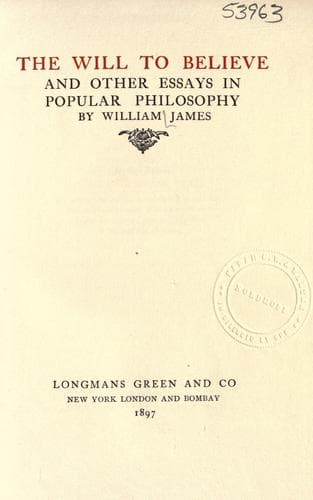
The Will to Believe, and Other Essays in Popular PhilosophyJames, William
Religion
The Will to Believe, and Other Essays in Popular Philosophy
James, William
Belief and doubt; Essays; Philosophy
If we survey the field of history and ask what feature all great
periods of revival, of expansion of the human mind, display in common,
we shall find, I think, simply this: that each and all of them have
said to the human being, "The inmost nature of the reality is congenial
to _powers_ which you possess." In what did the emancipating message
of primitive Christianity consist but in the announcement that {87} God
recognizes those weak and tender impulses which paganism had so rudely
overlooked? Take repentance: the man who can do nothing rightly can at
least repent of his failures. But for paganism this faculty of
repentance was a pure supernumerary, a straggler too late for the fair.
Christianity took it, and made it the one power within us which
appealed straight to the heart of God. And after the night of the
middle ages had so long branded with obloquy even the generous impulses
of the flesh, and defined the reality to be such that only slavish
natures could commune with it, in what did the _sursum corda_ of the
platonizing renaissance lie but in the proclamation that the archetype
of verity in things laid claim on the widest activity of our whole
aesthetic being? What were Luther's mission and Wesley's but appeals
to powers which even the meanest of men might carry with them,--faith
and self-despair,--but which were personal, requiring no priestly
intermediation, and which brought their owner face to face with God?
What caused the wildfire influence of Rousseau but the assurance he
gave that man's nature was in harmony with the nature of things, if
only the paralyzing corruptions of custom would stand from between?
How did Kant and Fichte, Goethe and Schiller, inspire their time with
cheer, except by saying, "Use all your powers; that is the only
obedience the universe exacts"? And Carlyle with his gospel of work,
of fact, of veracity, how does he move us except by saying that the
universe imposes no tasks upon us but such as the most humble can
perform? Emerson's creed that everything that ever was or will be is
here in the enveloping now; that man has but to obey himself,--"He who
will rest in what he _is_, {88} is a part of destiny,"--is in like
manner nothing but an exorcism of all scepticism as to the pertinency
of one's natural faculties.
Public-domain text, read in full here on John Shaqi.
Reviews
Reviews
No reviews yet
Be the first to share your thoughts on this work.
Elsewhere in the archive
Join the Discussion
Join the discussion
Sign in to leave a comment or review.
Sign InorCreate an account