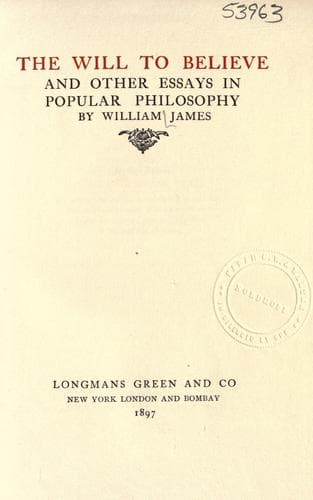
The Will to Believe, and Other Essays in Popular PhilosophyJames, William
Religion
The Will to Believe, and Other Essays in Popular Philosophy
James, William
Belief and doubt; Essays; Philosophy
Take idealism and materialism as examples of what I mean, and suppose
for a moment that both give a conception of equal theoretic clearness
and consistency, and that both determine our expectations equally well.
Idealism will be chosen by a man of one emotional constitution,
materialism by another. At this very day all sentimental natures, fond
of conciliation and intimacy, tend to an idealistic faith. Why?
Because idealism gives to the nature of things such kinship with our
personal selves. Our own thoughts are what we are most at home with,
what we are least afraid of. To say then that the universe essentially
is thought, is to say that I myself, potentially at least, am all.
There is no radically alien corner, but an all-pervading _intimacy_.
Now, in certain sensitively egotistic minds this conception of reality
is sure to put on a narrow, close, sick-room air. Everything
sentimental and priggish will be consecrated by it. That element in
reality which every strong man of common-sense willingly feels there
because it calls forth {90} powers that he owns--the rough, harsh,
sea-wave, north-wind element, the denier of persons, the
democratizer--is banished because it jars too much on the desire for
communion. Now, it is the very enjoyment of this element that throws
many men upon the materialistic or agnostic hypothesis, as a polemic
reaction against the contrary extreme. They sicken at a life wholly
constituted of intimacy. There is an overpowering desire at moments to
escape personality, to revel in the action of forces that have no
respect for our ego, to let the tides flow, even though they flow over
us. The strife of these two kinds of mental temper will, I think,
always be seen in philosophy. Some men will keep insisting on the
reason, the atonement, that lies in the heart of things, and that we
can act _with_; others, on the opacity of brute fact that we must react
_against_.
Public-domain text, read in full here on John Shaqi.
Reviews
Reviews
No reviews yet
Be the first to share your thoughts on this work.
Elsewhere in the archive
Join the Discussion
Join the discussion
Sign in to leave a comment or review.
Sign InorCreate an account