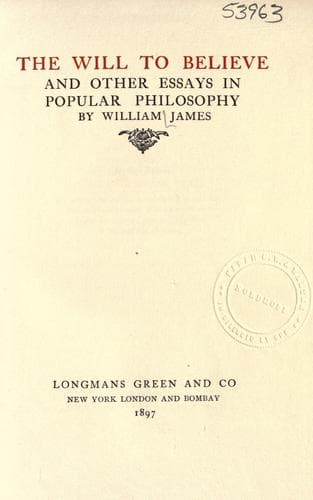
The Will to Believe, and Other Essays in Popular PhilosophyJames, William
Religion
The Will to Believe, and Other Essays in Popular Philosophy
James, William
Belief and doubt; Essays; Philosophy
Now, there is one element of our active nature which the Christian
religion has emphatically recognized, but which philosophers as a rule
have with great insincerity tried to huddle out of sight in their
pretension to found systems of absolute certainty. I mean the element
of faith. Faith means belief in something concerning which doubt is
still theoretically possible; and as the test of belief is willingness
to act, one may say that faith is the readiness to act in a cause the
prosperous issue of which is not certified to us in advance. It is in
fact the same moral quality which we call courage in practical affairs;
and there will be a very widespread tendency in men of vigorous nature
to enjoy a certain amount of uncertainty in their philosophic creed,
just as risk lends a zest to worldly activity. Absolutely certified
philosophies {91} seeking the _inconcussum_ are fruits of mental
natures in which the passion for identity (which we saw to be but one
factor of the rational appetite) plays an abnormally exclusive part.
In the average man, on the contrary, the power to trust, to risk a
little beyond the literal evidence, is an essential function. Any mode
of conceiving the universe which makes an appeal to this generous
power, and makes the man seem as if he were individually helping to
create the actuality of the truth whose metaphysical reality he is
willing to assume, will be sure to be responded to by large numbers.
The necessity of faith as an ingredient in our mental attitude is
strongly insisted on by the scientific philosophers of the present day;
but by a singularly arbitrary caprice they say that it is only
legitimate when used in the interests of one particular
proposition,--the proposition, namely, that the course of nature is
uniform. That nature will follow to-morrow the same laws that she
follows to-day is, they all admit, a truth which no man can _know_; but
in the interests of cognition as well as of action we must postulate or
assume it. As Helmholtz says: "Hier gilt nur der eine Rath: vertraue
und handle!" And Professor Bain urges: "Our only error is in proposing
to give any reason or justification of the postulate, or to treat it as
otherwise than begged at the very outset."
Public-domain text, read in full here on John Shaqi.
Reviews
Reviews
No reviews yet
Be the first to share your thoughts on this work.
Elsewhere in the archive
Join the Discussion
Join the discussion
Sign in to leave a comment or review.
Sign InorCreate an account