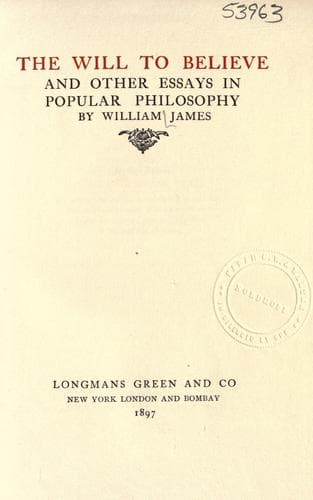
The Will to Believe, and Other Essays in Popular PhilosophyJames, William
Religion
The Will to Believe, and Other Essays in Popular Philosophy
James, William
Belief and doubt; Essays; Philosophy
practical refutation by bringing about a general deadlock. Each good
man hanging back and waiting for orders from the rest, absolute
stagnation would ensue. Happy, then, if a few unrighteous ones
contribute an initiative which sets things moving again!
All this is no caricature. That the course of destiny may be altered
by individuals no wise evolutionist ought to doubt. Everything for him
has small beginnings, has a bud which may be 'nipped,' and nipped by a
feeble force. Human races and tendencies follow the law, and have also
small beginnings. The best, according to evolution, is that which has
the biggest endings. Now, if a present race of men, enlightened in the
evolutionary philosophy, and able to forecast the future, were able to
discern in a tribe arising near them the potentiality of future
supremacy; were able to see that their own {100} race would eventually
be wiped out of existence by the new-comers if the expansion of these
were left unmolested,--these present sages would have two courses open
to them, either perfectly in harmony with the evolutionary test:
Strangle the new race now, and ours survives; help the new race, and it
survives. In both cases the action is right as measured by the
evolutionary standard,--it is action for the winning side.
Thus the evolutionist foundation of ethics is purely objective only to
the herd of nullities whose votes count for zero in the march of
events. But for others, leaders of opinion or potentates, and in
general those to whose actions position or genius gives a far-reaching
import, and to the rest of us, each in his measure,--whenever we
espouse a cause we contribute to the determination of the evolutionary
standard of right. The truly wise disciple of this school will then
admit faith as an ultimate ethical factor. Any philosophy which makes
such questions as, What is the ideal type of humanity? What shall be
reckoned virtues? What conduct is good? depend on the question, What
is going to succeed?--must needs fall back on personal belief as one of
the ultimate conditions of the truth. For again and again success
depends on energy of act; energy again depends on faith that we shall
not fail; and that faith in turn on the faith that we are right,--which
faith thus verifies itself.
Public-domain text, read in full here on John Shaqi.
Reviews
Reviews
No reviews yet
Be the first to share your thoughts on this work.
Elsewhere in the archive
Join the Discussion
Join the discussion
Sign in to leave a comment or review.
Sign InorCreate an account