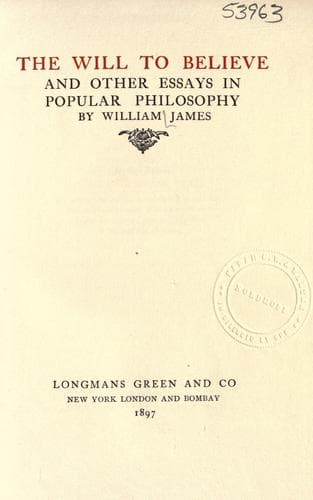
The Will to Believe, and Other Essays in Popular PhilosophyJames, William
Religion
The Will to Believe, and Other Essays in Popular Philosophy
James, William
Belief and doubt; Essays; Philosophy
In every proposition whose bearing is universal (and such are all the
propositions of philosophy), the acts of the subject and their
consequences throughout eternity should be included in the formula. If
_M_ {98} represent the entire world _minus_ the reaction of the thinker
upon it, and if _M_ + _x_ represent the absolutely total matter of
philosophic propositions (_x_ standing for the thinker's reaction and
its results),--what would be a universal truth if the term x were of
one complexion, might become egregious error if _x_ altered its
character. Let it not be said that _x_ is too infinitesimal a
component to change the character of the immense whole in which it lies
imbedded. Everything depends on the point of view of the philosophic
proposition in question. If we have to define the universe from the
point of view of sensibility, the critical material for our judgment
lies in the animal kingdom, insignificant as that is, quantitatively
considered. The moral definition of the world may depend on phenomena
more restricted still in range. In short, many a long phrase may have
its sense reversed by the addition of three letters, _n-o-t_; many a
monstrous mass have its unstable equilibrium discharged one way or the
other by a feather weight that falls.
Let us make this clear by a few examples. The philosophy of evolution
offers us to-day a new criterion to serve as an ethical test between
right and wrong. Previous criteria, it says, being subjective, have
left us still floundering in variations of opinion and the _status
belli_. Here is a criterion which is objective and fixed: _That is to
be called good which is destined to prevail or survive_. But we
immediately see that this standard can only remain objective by leaving
myself and my conduct out. If what prevails and survives does so by my
help, and cannot do so without that help; if something else will
prevail in case I alter my conduct,--how can I possibly now, conscious
of alternative courses of action open before me, either of which {99} I
may suppose capable of altering the path of events, decide which course
to take by asking what path events will follow? If they follow my
direction, evidently my direction cannot wait on them. The only
possible manner in which an evolutionist can use his standard is the
obsequious method of forecasting the course society would take _but for
him_, and then putting an extinguisher on all personal idiosyncrasies
of desire and interest, and with bated breath and tiptoe tread
following as straight as may be at the tail, and bringing up the rear
of everything. Some pious creatures may find a pleasure in this; but
not only does it violate our general wish to lead and not to follow (a
wish which is surely not immoral if we but lead aright), but if it be
treated as every ethical principle must be treated,--namely, as a rule
good for all men alike,--its general observance would lead to its
Public-domain text, read in full here on John Shaqi.
Reviews
Reviews
No reviews yet
Be the first to share your thoughts on this work.
Elsewhere in the archive
Join the Discussion
Join the discussion
Sign in to leave a comment or review.
Sign InorCreate an account