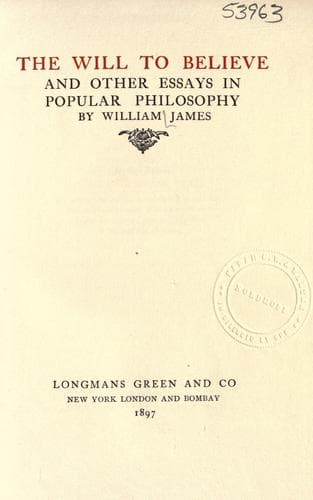
The Will to Believe, and Other Essays in Popular PhilosophyJames, William
Religion
The Will to Believe, and Other Essays in Popular Philosophy
James, William
Belief and doubt; Essays; Philosophy
"Little inconveniences, exertions, pains.--these are the only things in
which we rightly feel our life at all. If these be not there,
existence becomes worthless, or worse; {102} success in putting them
all away is fatal. So it is men engage in athletic sports, spend their
holidays in climbing up mountains, find nothing so enjoyable as that
which taxes their endurance and their energy. This is the way we are
made, I say. It may or may not be a mystery or a paradox; it is a
fact. Now, this enjoyment in endurance is just according to the
intensity of life: the more physical vigor and balance, the more
endurance can be made an element of satisfaction. A sick man cannot
stand it. The line of enjoyable suffering is not a fixed one; it
fluctuates with the perfectness of the life. That our pains are, as
they are, unendurable, awful, overwhelming, crushing, not to be borne
save in misery and dumb impatience, which utter exhaustion alone makes
patient,--that our pains are thus unendurable, means not that they are
too great, but that _we are sick_. We have not got our proper life.
So you perceive pain is no more necessarily an evil, but an essential
element of the highest good."[3]
But the highest good can be achieved only by our getting our proper
life; and that can come about only by help of a moral energy born of
the faith that in some way or other we shall succeed in getting it if
we try pertinaciously enough. This world _is_ good, we must say, since
it is what we make it,--and we shall make it good. How can we exclude
from the cognition of a truth a faith which is involved in the creation
of the truth? _M_ has its character indeterminate, susceptible of
forming part of a thorough-going pessimism on the one hand, or of a
meliorism, a moral (as distinguished from a sensual) optimism on the
other. All depends on the character of the {103} personal contribution
_x_. Wherever the facts to be formulated contain such a contribution,
we may logically, legitimately, and inexpugnably believe what we
desire. The belief creates its verification. The thought becomes
literally father to the fact, as the wish was father to the thought.[4]
Public-domain text, read in full here on John Shaqi.
Reviews
Reviews
No reviews yet
Be the first to share your thoughts on this work.
Elsewhere in the archive
Join the Discussion
Join the discussion
Sign in to leave a comment or review.
Sign InorCreate an account