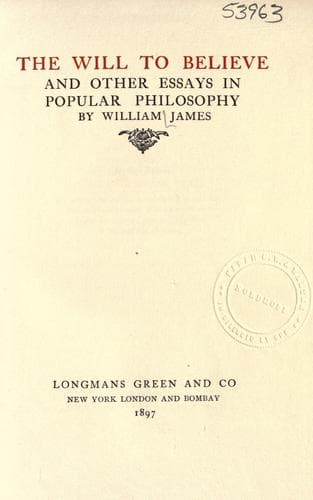
The Will to Believe, and Other Essays in Popular PhilosophyJames, William
Religion
The Will to Believe, and Other Essays in Popular Philosophy
James, William
Belief and doubt; Essays; Philosophy
Let us now turn to the radical question of life,--the question whether
this be at bottom a moral or an unmoral universe,--and see whether the
method of faith may legitimately have a place there. It is really the
question of materialism. Is the world a simple brute actuality, an
existence _de facto_ about which the deepest thing that can be said is
that it happens so to be; or is the judgment of _better_ or worse, of
_ought_, as intimately pertinent to phenomena as the simple judgment
_is_ or _is not_? The materialistic theorists say that judgments of
worth are themselves mere matters of fact; that the words 'good' and
'bad' have no sense apart from subjective passions and interests which
we may, if we please, play fast and loose with at will, so far as any
duty of ours to the non-human universe is concerned. Thus, when a
materialist says it is better for him to suffer great inconvenience
than to break a promise, he only means that his social interests have
become so knit up with {104} keeping faith that, those interests once
being granted, it is better for him to keep the promise in spite of
everything. But the interests themselves are neither right nor wrong,
except possibly with reference to some ulterior order of interests
which themselves again are mere subjective data without character,
either good or bad.
For the absolute moralists, on the contrary, the interests are not
there merely to be felt,--they are to be believed in and obeyed. Not
only is it best for my social interests to keep my promise, but best
for me to have those interests, and best for the cosmos to have this
me. Like the old woman in the story who described the world as resting
on a rock, and then explained that rock to be supported by another
rock, and finally when pushed with questions said it was rocks all the
way down,--he who believes this to be a radically moral universe must
hold the moral order to rest either on an absolute and ultimate
_should_, or on a series of _shoulds_ all the way down.[5]
Public-domain text, read in full here on John Shaqi.
Reviews
Reviews
No reviews yet
Be the first to share your thoughts on this work.
Elsewhere in the archive
Join the Discussion
Join the discussion
Sign in to leave a comment or review.
Sign InorCreate an account