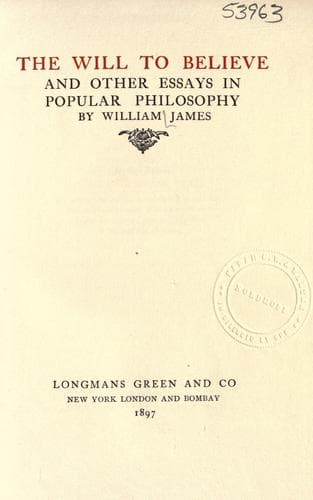
The Will to Believe, and Other Essays in Popular PhilosophyJames, William
Religion
The Will to Believe, and Other Essays in Popular Philosophy
James, William
Belief and doubt; Essays; Philosophy
The practical difference between this objective sort of moralist and
the other one is enormous. The subjectivist in morals, when his moral
feelings are at war with the facts about him, is always free to seek
harmony by toning down the sensitiveness of the feelings. Being mere
data, neither good nor evil in themselves, he may pervert them or lull
them to sleep by any means at his command. Truckling, compromise,
time-serving, capitulations of conscience, are conventionally
opprobrious names for what, if successfully carried out, {105} would be
on his principles by far the easiest and most praiseworthy mode of
bringing about that harmony between inner and outer relations which is
all that he means by good. The absolute moralist, on the other hand,
when his interests clash with the world, is not free to gain harmony by
sacrificing the ideal interests. According to him, these latter should
be as they are and not otherwise. Resistance then, poverty, martyrdom
if need be, tragedy in a word,--such are the solemn feasts of his
inward faith. Not that the contradiction between the two men occurs
every day; in commonplace matters all moral schools agree. It is only
in the lonely emergencies of life that our creed is tested: then
routine maxims fail, and we fall back on our gods. It cannot then be
said that the question, Is this a moral world? is a meaningless and
unverifiable question because it deals with something non-phenomenal.
Any question is full of meaning to which, as here, contrary answers
lead to contrary behavior. And it seems as if in answering such a
question as this we might proceed exactly as does the physical
philosopher in testing an hypothesis. He deduces from the hypothesis
an experimental action, _x_; this he adds to the facts _M_ already
existing. It fits them if the hypothesis be true; if not, there is
discord. The results of the action corroborate or refute the idea from
which it flowed. So here: the verification of the theory which you may
hold as to the objectively moral character of the world can consist
only in this,--that if you proceed to act upon your theory it will be
reversed by nothing that later turns up as your action's fruit; it will
harmonize so well with the entire drift of experience that the latter
will, as it were, adopt it, or at most give it an ampler {106}
interpretation, without obliging you in any way to change the essence
of its formulation. If this be an objectively moral universe, all acts
that I make on that assumption, all expectations that I ground on it,
will tend more and more completely to interdigitate with the phenomena
already existing. _M_ + _x_ will be in accord; and the more I live,
and the more the fruits of my activity come to light, the more
satisfactory the consensus will grow. While if it be not such a moral
universe, and I mistakenly assume that it is, the course of experience
will throw ever new impediments in the way of my belief, and become
Public-domain text, read in full here on John Shaqi.
Reviews
Reviews
No reviews yet
Be the first to share your thoughts on this work.
Elsewhere in the archive
Join the Discussion
Join the discussion
Sign in to leave a comment or review.
Sign InorCreate an account