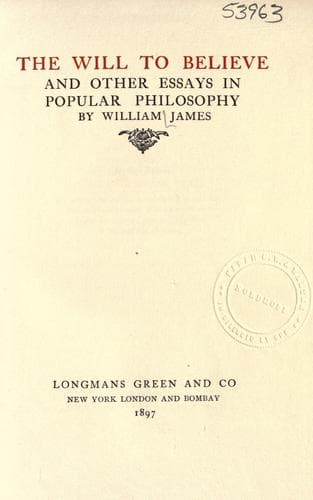
The Will to Believe, and Other Essays in Popular PhilosophyJames, William
Religion
The Will to Believe, and Other Essays in Popular Philosophy
James, William
Belief and doubt; Essays; Philosophy
For the sake of simplicity I have written as if the verification might
occur in the life of a single philosopher,--which is manifestly untrue,
since the theories still face each other, and the facts of the world
give countenance to both. Rather should we expect, that, in a question
of this scope, the experience of the entire human race must make the
verification, and that all the evidence will not be 'in' till the final
integration of things, when the last man has had his say and
contributed his share to the still unfinished _x_. Then the proof will
be complete; then it will appear without doubt whether the moralistic x
has filled up the gap which alone kept the _M_ of the world from
forming an even and harmonious unity, or whether the {108}
non-moralistic _x_ has given the finishing touches which were alone
needed to make the _M_ appear outwardly as vain as it inwardly was.
But if this be so, is it not clear that the facts _M_, taken _per se_,
are inadequate to justify a conclusion either way in advance of my
action? My action is the complement which, by proving congruous or
not, reveals the latent nature of the mass to which it is applied. The
world may in fact be likened unto a lock, whose inward nature, moral or
unmoral, will never reveal itself to our simply expectant gaze. The
positivists, forbidding us to make any assumptions regarding it,
condemn us to eternal ignorance, for the 'evidence' which they wait for
can never come so long as we are passive. But nature has put into our
hands two keys, by which we may test the lock. If we try the moral key
_and it fits_, it is a moral lock. If we try the unmoral key and _it_
fits, it is an unmoral lock. I cannot possibly conceive of any other
sort of 'evidence' or 'proof' than this. It is quite true that the
co-operation of generations is needed to educe it. But in these
matters the solidarity (so called) of the human race is a patent fact.
The essential thing to notice is that our active preference is a
legitimate part of the game,--that it is our plain business as men to
try one of the keys, and the one in which we most confide. If then the
proof exist not till I have acted, and I must needs in acting run the
risk of being wrong, how can the popular science professors be right in
objurgating in me as infamous a 'credulity' which the strict logic of
the situation requires? If this really be a moral universe; if by my
acts I be a factor of its destinies; if to believe where I may doubt be
itself a moral act {109} analogous to voting for a side not yet sure to
win,--by what right shall they close in upon me and steadily negate the
deepest conceivable function of my being by their preposterous command
that I shall stir neither hand nor foot, but remain balancing myself in
eternal and insoluble doubt? Why, doubt itself is a decision of the
widest practical reach, if only because we may miss by doubting what
goods we might be gaining by espousing the winning side. But more than
Public-domain text, read in full here on John Shaqi.
Reviews
Reviews
No reviews yet
Be the first to share your thoughts on this work.
Elsewhere in the archive
Join the Discussion
Join the discussion
Sign in to leave a comment or review.
Sign InorCreate an account