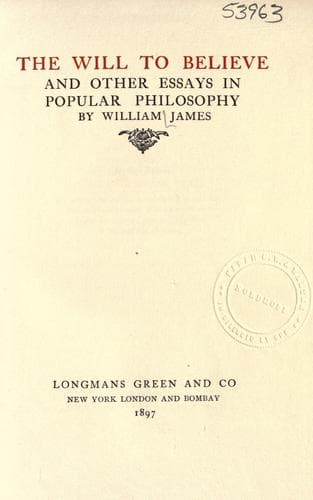
The Will to Believe, and Other Essays in Popular PhilosophyJames, William
Religion
The Will to Believe, and Other Essays in Popular Philosophy
James, William
Belief and doubt; Essays; Philosophy
that! it is often practically impossible to distinguish doubt from
dogmatic negation. If I refuse to stop a murder because I am in doubt
whether it be not justifiable homicide, I am virtually abetting the
crime. If I refuse to bale out a boat because I am in doubt whether my
efforts will keep her afloat, I am really helping to sink her. If in
the mountain precipice I doubt my right to risk a leap, I actively
connive at my destruction. He who commands himself not to be credulous
of God, of duty, of freedom, of immortality, may again and again be
indistinguishable from him who dogmatically denies them. Scepticism in
moral matters is an active ally of immorality. Who is not for is
against. The universe will have no neutrals in these questions. In
theory as in practice, dodge or hedge, or talk as we like about a wise
scepticism, we are really doing volunteer military service for one side
or the other.
Yet obvious as this necessity practically is, thousands of innocent
magazine readers lie paralyzed and terrified in the network of shallow
negations which the leaders of opinion have thrown over their souls.
All they need to be free and hearty again in the exercise of their
birthright is that these fastidious vetoes should be swept away. All
that the human {110} heart wants is its chance. It will willingly
forego certainty in universal matters if only it can be allowed to feel
that in them it has that same inalienable right to run risks, which no
one dreams of refusing to it in the pettiest practical affairs. And if
I, in these last pages, like the mouse in the fable, have gnawed a few
of the strings of the sophistical net that has been binding down its
lion-strength, I shall be more than rewarded for my pains.
To sum up: No philosophy will permanently be deemed rational by all men
which (in addition to meeting logical demands) does not to some degree
pretend to determine expectancy, and in a still greater degree make a
direct appeal to all those powers of our nature which we hold in
highest esteem. Faith, being one of these powers, will always remain a
factor not to be banished from philosophic constructions, the more so
since in many ways it brings forth its own verification. In these
points, then, it is hopeless to look for literal agreement among
mankind.
The ultimate philosophy, we may therefore conclude, must not be too
strait-laced in form, must not in all its parts divide heresy from
orthodoxy by too sharp a line. There must be left over and above the
propositions to be subscribed, _ubique, semper, et ab omnibus_, another
realm into which the stifled soul may escape from pedantic scruples and
indulge its own faith at its own risks; and all that can here be done
will be to mark out distinctly the questions which fall within faith's
sphere.
Public-domain text, read in full here on John Shaqi.
Reviews
Reviews
No reviews yet
Be the first to share your thoughts on this work.
Elsewhere in the archive
Join the Discussion
Join the discussion
Sign in to leave a comment or review.
Sign InorCreate an account