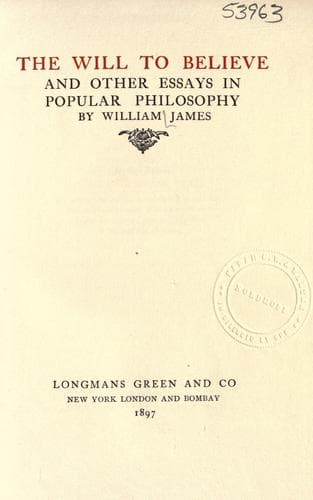
The Will to Believe, and Other Essays in Popular PhilosophyJames, William
Religion
The Will to Believe, and Other Essays in Popular Philosophy
James, William
Belief and doubt; Essays; Philosophy
[1] This essay as far as page 75 consists of extracts from an article
printed in Mind for July, 1879. Thereafter it is a reprint of an
address to the Harvard Philosophical Club, delivered in 1880, and
published in the Princeton Review, July, 1882.
[2] At most, the command laid upon us by science to believe nothing not
yet verified by the senses is a prudential rule intended to maximize
our right thinking and minimize our errors _in the long run_. In the
particular instance we must frequently lose truth by obeying it; but on
the whole we are safer if we follow it consistently, for we are sure to
cover our losses with our gains. It is like those gambling and
insurance rules based on probability, in which we secure ourselves
against losses in detail by hedging on the total run. But this hedging
philosophy requires that long run should be there; and this makes it
inapplicable to the question of religious faith as the latter comes
home to the individual man. He plays the game of life not to escape
losses, for he brings nothing with him to lose; he plays it for gains;
and it is now or never with him, for the long run which exists indeed
for humanity, is not there for him. Let him doubt, believe, or deny,
he runs his risk, and has the natural right to choose which one it
shall be.
[3] Life of James Hinton, pp. 172, 173. See also the excellent chapter
on Faith and Sight in the Mystery of Matter, by J. Allanson Picton.
Hinton's Mystery of Pain will undoubtedly always remain the classical
utterance on this subject.
[4] Observe that in all this not a word has been said of free-will. It
all applies as well to a predetermined as to an indeterminate universe.
If _M_ + _x_ is fixed in advance, the belief which leads to _x_ and the
desire which prompts the belief are also fixed. But fixed or not,
these subjective states form a phenomenal condition necessarily
preceding the facts; necessarily constitutive, therefore, of the truth
_M_ + _x_ which we seek. If, however, free acts be possible, a faith
in their possibility, by augmenting the moral energy which gives them
birth, will increase their frequency in a given individual.
[5] In either case, as a later essay explains (see p. 193), the
_should_ which the moralist regards as binding upon him must be rooted
in the feeling of some other thinker, or collection of thinkers, to
whose demands he individually bows.
{111}
REFLEX ACTION AND THEISM.[1]
MEMBERS OF THE MINISTERS' INSTITUTE:
Public-domain text, read in full here on John Shaqi.
Reviews
Reviews
No reviews yet
Be the first to share your thoughts on this work.
Elsewhere in the archive
Join the Discussion
Join the discussion
Sign in to leave a comment or review.
Sign InorCreate an account