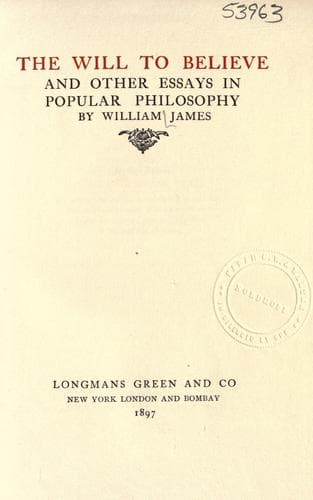
The Will to Believe, and Other Essays in Popular PhilosophyJames, William
Religion
The Will to Believe, and Other Essays in Popular Philosophy
James, William
Belief and doubt; Essays; Philosophy
This being the case, I know you will justify me if I fall back on a
doctrine which is fundamental and well established rather than novel,
and ask you whether {113} by taking counsel together we may not trace
some new consequences from it which shall interest us all alike as men.
I refer to the doctrine of reflex action, especially as extended to the
brain. This is, of course, so familiar to you that I hardly need
define it. In a general way, all educated people know what reflex
action means.
It means that the acts we perform are always the result of outward
discharges from the nervous centres, and that these outward discharges
are themselves the result of impressions from the external world,
carried in along one or another of our sensory nerves. Applied at
first to only a portion of our acts, this conception has ended by being
generalized more and more, so that now most physiologists tell us that
every action whatever, even the most deliberately weighed and
calculated, does, so far as its organic conditions go, follow the
reflex type. There is not one which cannot be remotely, if not
immediately, traced to an origin in some incoming impression of sense.
There is no impression of sense which, unless inhibited by some other
stronger one, does not immediately or remotely express itself in action
of some kind. There is no one of those complicated performances in the
convolutions of the brain to which our trains of thought correspond,
which is not a mere middle term interposed between an incoming
sensation that arouses it and an outgoing discharge of some sort,
inhibitory if not exciting, to which itself gives rise. The structural
unit of the nervous system is in fact a triad, neither of whose
elements has any independent existence. The sensory impression exists
only for the sake of awaking the central process of reflection, and the
central process of reflection exists {114} only for the sake of calling
forth the final act. All action is thus _re_-action upon the outer
world; and the middle stage of consideration or contemplation or
thinking is only a place of transit, the bottom of a loop, both whose
ends have their point of application in the outer world. If it should
ever have no roots in the outer world, if it should ever happen that it
led to no active measures, it would fail of its essential function, and
would have to be considered either pathological or abortive. The
current of life which runs in at our eyes or ears is meant to run out
at our hands, feet, or lips. The only use of the thoughts it occasions
while inside is to determine its direction to whichever of these organs
shall, on the whole, under the circumstances actually present, act in
the way most propitious to our welfare.
The willing department of our nature, in short, dominates both the
conceiving department and the feeling department; or, in plainer
English, perception and thinking are only there for behavior's sake.
Public-domain text, read in full here on John Shaqi.
Reviews
Reviews
No reviews yet
Be the first to share your thoughts on this work.
Elsewhere in the archive
Join the Discussion
Join the discussion
Sign in to leave a comment or review.
Sign InorCreate an account