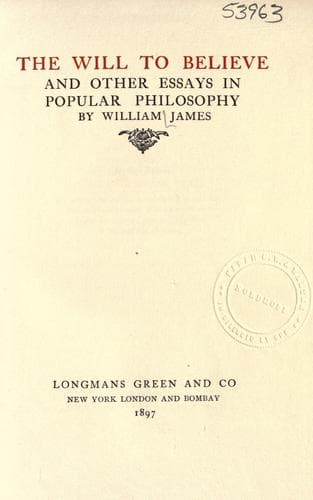
The Will to Believe, and Other Essays in Popular PhilosophyJames, William
Religion
The Will to Believe, and Other Essays in Popular Philosophy
James, William
Belief and doubt; Essays; Philosophy
I am sure I am not wrong in stating this result as one of the
fundamental conclusions to which the entire drift of modern
physiological investigation sweeps us. If asked what great
contribution physiology has made to psychology of late years, I am sure
every competent authority will reply that her influence has in no way
been so weighty as in the copious illustration, verification, and
consolidation of this broad, general point of view.
I invite you, then, to consider what may be the possible speculative
consequences involved in this great achievement of our generation.
Already, it dominates all the new work done in psychology; but {115}
what I wish to ask is whether its influence may not extend far beyond
the limits of psychology, even into those of theology herself. The
relations of the doctrine of reflex action with no less a matter than
the doctrine of theism is, in fact, the topic to which I now invite
your attention.
We are not the first in the field. There have not been wanting writers
enough to say that reflex action and all that follows from it give the
_coup de grâce_ to the superstition of a God.
If you open, for instance, such a book on comparative psychology, as
der Thierische Wille of G. H. Schneider, you will find, sandwiched in
among the admirable dealings of the author with his proper subject, and
popping out upon us in unexpected places, the most delightfully _naïf_
German onslaughts on the degradation of theologians, and the utter
incompatibility of so many reflex adaptations to the environment with
the existence of a creative intelligence. There was a time, remembered
by many of us here, when the existence of reflex action and all the
other harmonies between the organism and the world were held to prove a
God. Now, they are held to disprove him. The next turn of the
whirligig may bring back proof of him again.
Into this debate about his existence, I will not pretend to enter. I
must take up humbler ground, and limit my ambition to showing that a
God, whether existent or not, is at all events the kind of being which,
if he did exist, would form _the most adequate possible object_ for
minds framed like our own to conceive as lying at the root of the
universe. My thesis, in other words, is this: that some outward
reality of {116} a nature defined as God's nature must be defined, is
the only ultimate object that is at the same time rational and possible
for the human mind's contemplation. _Anything short of God is not
rational, anything more than God is not possible_, if the human mind be
in truth the triadic structure of impression, reflection, and reaction
which we at the outset allowed.
Public-domain text, read in full here on John Shaqi.
Reviews
Reviews
No reviews yet
Be the first to share your thoughts on this work.
Elsewhere in the archive
Join the Discussion
Join the discussion
Sign in to leave a comment or review.
Sign InorCreate an account