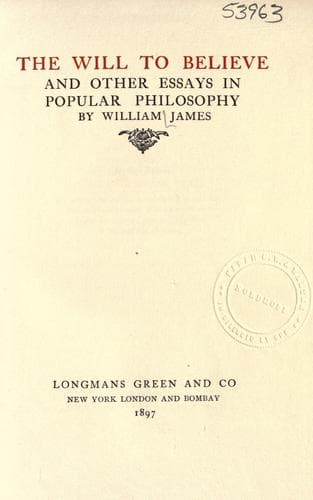
The Will to Believe, and Other Essays in Popular PhilosophyJames, William
Religion
The Will to Believe, and Other Essays in Popular Philosophy
James, William
Belief and doubt; Essays; Philosophy
But, first of all, let me ask you to linger a moment longer over what I
have called the reflex theory of mind, so as to be sure that we
understand it absolutely before going on to consider those of its
consequences of which I am more particularly to speak. I am not quite
sure that its full scope is grasped even by those who have most
zealously promulgated it. I am not sure, for example, that all
physiologists see that it commits them to regarding the mind as an
essentially teleological mechanism. I mean by this that the conceiving
or theorizing faculty--the mind's middle department--functions
_exclusively for the sake of ends_ that do not exist at all in the
world of impressions we receive by way of our senses, but are set by
our emotional and practical subjectivity altogether.[2] It is a
transformer of the world of our impressions into a totally different
world,--the world of our conception; and the transformation is effected
in the interests of our volitional nature, and for no other purpose
whatsoever. Destroy the volitional nature, the definite subjective
purposes, preferences, {118} fondnesses for certain effects, forms,
orders, and not the slightest motive would remain for the brute order
of our experience to be remodelled at all. But, as we have the
elaborate volitional constitution we do have, the remodelling must be
effected; there is no escape. The world's contents are _given_ to each
of us in an order so foreign to our subjective interests that we can
hardly by an effort of the imagination picture to ourselves what it is
like. We have to break that order altogether,--and by picking out from
it the items which concern us, and connecting them with others far
away, which we say 'belong' with them, we are able to make out definite
threads of sequence and tendency; to foresee particular liabilities and
get ready for them; and to enjoy simplicity and harmony in place of
what was chaos. Is not the sum of your actual experience taken at this
moment and impartially added together an utter chaos? The strains of
my voice, the lights and shades inside the room and out, the murmur of
the wind, the ticking of the clock, the various organic feelings you
may happen individually to possess, do these make a whole at all? Is
it not the only condition of your mental sanity in the midst of them
that most of them should become non-existent for you, and that a few
others--the sounds, I hope, which I am uttering--should evoke from
places in your memory that have nothing to do with this scene
associates fitted to combine with them in what we call a rational train
of thought,--rational, because it leads to a conclusion which we have
some organ to appreciate? We have no organ or faculty to appreciate
the simply given order. The real world as it is given objectively at
this moment is the sum total of all its beings and {119} events now.
But can we think of such a sum? Can we realize for an instant what a
Public-domain text, read in full here on John Shaqi.
Reviews
Reviews
No reviews yet
Be the first to share your thoughts on this work.
Elsewhere in the archive
Join the Discussion
Join the discussion
Sign in to leave a comment or review.
Sign InorCreate an account