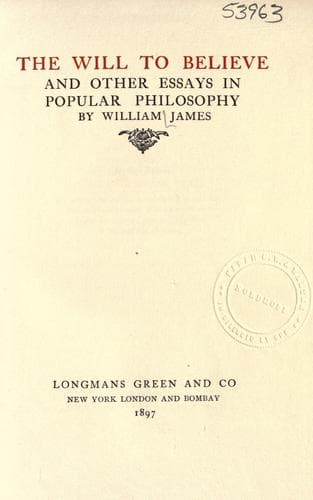
The Will to Believe, and Other Essays in Popular PhilosophyJames, William
Religion
The Will to Believe, and Other Essays in Popular Philosophy
James, William
Belief and doubt; Essays; Philosophy
cross-section of all existence at a definite point of time would be?
While I talk and the flies buzz, a sea-gull catches a fish at the mouth
of the Amazon, a tree falls in the Adirondack wilderness, a man sneezes
in Germany, a horse dies in Tartary, and twins are born in France.
What does that mean? Does the contemporaneity of these events with one
another and with a million others as disjointed, form a rational bond
between them, and unite them into anything that means for us a world?
Yet just such a collateral contemporaneity, and nothing else, is the
real order of the world. It is an order with which we have nothing to
do but to get away from it as fast as possible. As I said, we break
it: we break it into histories, and we break it into arts, and we break
it into sciences; and then we begin to feel at home. We make ten
thousand separate serial orders of it, and on any one of these we react
as though the others did not exist. We discover among its various
parts relations that were never given to sense at all (mathematical
relations, tangents, squares, and roots and logarithmic functions), and
out of an infinite number of these we call certain ones essential and
lawgiving, and ignore the rest. Essential these relations are, but
only _for our purpose_, the other relations being just as real and
present as they; and our purpose is to _conceive simply_ and to
_foresee_. Are not simple conception and prevision subjective ends
pure and simple? They are the ends of what we call science; and the
miracle of miracles, a miracle not yet exhaustively cleared up by any
philosophy, is that the given order lends itself to the remodelling.
It shows itself plastic to many of our scientific, to {120} many of our
aesthetic, to many of our practical purposes and ends.
When the man of affairs, the artist, or the man of science fails, he is
not rebutted. He tries again. He says the impressions of sense _must_
give way, _must_ be reduced to the desiderated form.[3] They all
postulate in the interests of their volitional nature a harmony between
the latter and the nature of things. The theologian does no more. And
the reflex doctrine of the mind's structure, though all theology should
as yet have failed of its endeavor, could but confess that the endeavor
itself at least obeyed in form the mind's most necessary law.[4]
Public-domain text, read in full here on John Shaqi.
Reviews
Reviews
No reviews yet
Be the first to share your thoughts on this work.
Elsewhere in the archive
Join the Discussion
Join the discussion
Sign in to leave a comment or review.
Sign InorCreate an account