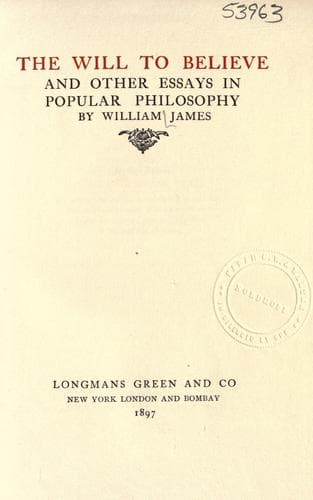
The Will to Believe, and Other Essays in Popular PhilosophyJames, William
Religion
The Will to Believe, and Other Essays in Popular Philosophy
James, William
Belief and doubt; Essays; Philosophy
Now, what are these essential features? First, it is essential that
God be conceived as the deepest power in the universe; and, second, he
must be conceived under the form of a mental personality. The
personality need not be determined intrinsically any further than is
involved in the holding of certain things dear, and in the recognition
of our dispositions toward those things, the things themselves being
all good and righteous things. But, extrinsically considered, so to
speak, God's personality is to be regarded, like any other personality,
as something lying outside of my own and other than me, and whose
existence I simply come upon and find. A power not ourselves, then,
which not only makes for righteousness, but means it, and which
recognizes us,--such is the definition which I think nobody will be
inclined to dispute. Various are the attempts to shadow forth the
other lineaments of so supreme a personality to our human imagination;
various the ways of conceiving in what mode the recognition, the
hearkening to our cry, can come. Some are gross and idolatrous; some
are the most sustained efforts man's intellect has ever made to keep
still living on that subtile edge of things where speech and thought
expire. But, with all these differences, the essence remains
unchanged. In whatever other respects the divine personality may
differ from ours or may resemble it, the two are consanguineous at
least in this,--that both have purposes for which they care, and each
can hear the other's call.
Meanwhile, we can already see one consequence and one point of
connection with the reflex-action theory of mind. Any mind,
constructed on the {123} triadic-reflex pattern, must first get its
impression from the object which it confronts; then define what that
object is, and decide what active measures its presence demands; and
finally react. The stage of reaction depends on the stage of
definition, and these, of course, on the nature of the impressing
object. When the objects are concrete, particular, and familiar, our
reactions are firm and certain enough,--often instinctive. I see the
desk, and lean on it; I see your quiet faces, and I continue to talk.
But the objects will not stay concrete and particular: they fuse
themselves into general essences, and they sum themselves into a
whole,--the universe. And then the object that confronts us, that
knocks on our mental door and asks to be let in, and fixed and decided
upon and actively met, is just this whole universe itself and its
essence.
What are _they_, and how shall I meet _them_?
Public-domain text, read in full here on John Shaqi.
Reviews
Reviews
No reviews yet
Be the first to share your thoughts on this work.
Elsewhere in the archive
Join the Discussion
Join the discussion
Sign in to leave a comment or review.
Sign InorCreate an account