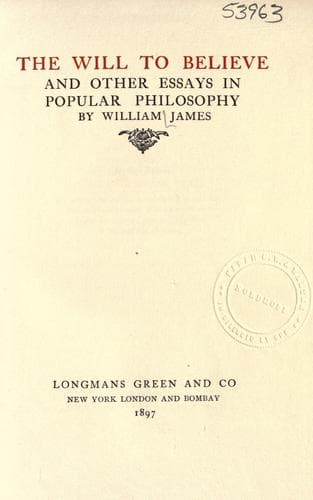
The Will to Believe, and Other Essays in Popular PhilosophyJames, William
Religion
The Will to Believe, and Other Essays in Popular Philosophy
James, William
Belief and doubt; Essays; Philosophy
The whole flood of faiths and systems here rush in. Philosophies and
denials of philosophy, religions and atheisms, scepticisms and
mysticisms, confirmed emotional moods and habitual practical biases,
jostle one another; for all are alike trials, hasty, prolix, or of
seemly length, to answer this momentous question. And the function of
them all, long or short, that which the moods and the systems alike
subserve and pass into, is the third stage,--the stage of action. For
no one of them itself is final. They form but the middle segment of
the mental curve, and not its termination. As the last theoretic pulse
dies away, it does not leave the mental process complete: it is but the
forerunner of the practical moment, in which alone the cycle of
mentality finds its rhythmic pause.
{124}
We easily delude ourselves about this middle stage. Sometimes we think
it final, and sometimes we fail to see, amid the monstrous diversity in
the length and complication of the cogitations which may fill it, that
it can have but one essential function, and that the one we have
pointed out,--the function of defining the direction which our
activity, immediate or remote, shall take.
If I simply say, "Vanitas vanitatum, omnia vanitas!" I am defining the
total nature of things in a way that carries practical consequences
with it as decidedly as if I write a treatise De Natura Rerum in twenty
volumes. The treatise may trace its consequences more minutely than
the saying; but the only worth of either treatise or saying is that the
consequences are there. The long definition can do no more than draw
them; the short definition does no less. Indeed, it may be said that
if two apparently different definitions of the reality before us should
have identical consequences, those two definitions would really be
identical definitions, made delusively to appear different merely by
the different verbiage in which they are expressed.[6]
Public-domain text, read in full here on John Shaqi.
Reviews
Reviews
No reviews yet
Be the first to share your thoughts on this work.
Elsewhere in the archive
Join the Discussion
Join the discussion
Sign in to leave a comment or review.
Sign InorCreate an account