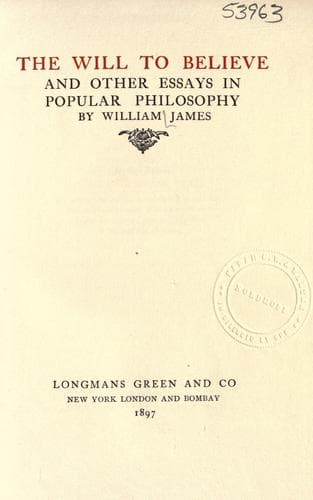
The Will to Believe, and Other Essays in Popular PhilosophyJames, William
Religion
The Will to Believe, and Other Essays in Popular Philosophy
James, William
Belief and doubt; Essays; Philosophy
Well, just as within the limits of theism some kinds are surviving
others by reason of their greater practical rationality, so theism
itself, by reason of its practical rationality, is certain to survive
all lower creeds. Materialism and agnosticism, even were they true,
could never gain universal and popular acceptance; for they both,
alike, give a solution of things which is irrational to the practical
third of our nature, and in which we can never volitionally feel at
home. Each comes out of the second or theoretic stage of mental
functioning, with its definition of the essential nature of things, its
formula of formulas prepared. The whole array of active forces of our
nature stands waiting, impatient for the word which shall tell them how
to discharge themselves most deeply and worthily upon life. "Well!"
cry they, "what shall we do?" "Ignoramus, ignorabimus!" says
agnosticism. "React upon atoms and their concussions!" says
materialism. What a collapse! The mental train misses fire, the
middle fails to ignite the end, the cycle breaks down half-way to its
conclusion; and the active {127} powers left alone, with no proper
object on which to vent their energy, must either atrophy, sicken, and
die, or else by their pent-up convulsions and excitement keep the whole
machinery in a fever until some less incommensurable solution, some
more practically rational formula, shall provide a normal issue for the
currents of the soul.
Now, theism always stands ready with the most practically rational
solution it is possible to conceive. Not an energy of our active
nature to which it does not authoritatively appeal, not an emotion of
which it does not normally and naturally release the springs. At a
single stroke, it changes the dead blank _it_ of the world into a
living _thou_, with whom the whole man may have dealings. To you, at
any rate, I need waste no words in trying to prove its supreme
commensurateness with all the demands that department Number Three of
the mind has the power to impose on department Number Two.
Our volitional nature must then, until the end of time, exert a
constant pressure upon the other departments of the mind to induce them
to function to theistic conclusions. No contrary formulas can be more
than provisionally held. Infra-theistic theories must be always in
unstable equilibrium; for department Number Three ever lurks in ambush,
ready to assert its rights, and on the slightest show of justification
it makes its fatal spring, and converts them into the other form in
which alone mental peace and order can permanently reign.
The question is, then, _Can_ departments One and Two, _can_ the facts
of nature and the theoretic elaboration of them, always lead to
theistic conclusions?
The future history of philosophy is the only {128} authority capable of
answering that question. I, at all events, must not enter into it
to-day, as that would be to abandon the purely natural-history point of
view I mean to keep.
Public-domain text, read in full here on John Shaqi.
Reviews
Reviews
No reviews yet
Be the first to share your thoughts on this work.
Elsewhere in the archive
Join the Discussion
Join the discussion
Sign in to leave a comment or review.
Sign InorCreate an account