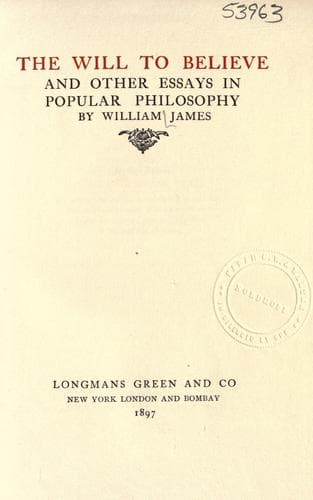
The Will to Believe, and Other Essays in Popular PhilosophyJames, William
Religion
The Will to Believe, and Other Essays in Popular Philosophy
James, William
Belief and doubt; Essays; Philosophy
My time is unfortunately too short to stay and give to this truth the
development it deserves; but I will assume that you grant it without
further parley, and pass to the next step in my argument. And here,
too, I shall have to bespeak your close attention for a moment, while I
pass over the subject far more {125} rapidly than it deserves. Whether
true or false, any view of the universe which shall completely satisfy
the mind must obey conditions of the mind's own imposing, must at least
let the mind be the umpire to decide whether it be fit to be called a
rational universe or not. Not any nature of things which may seem to
be will also seem to be _ipso facto_ rational; and if it do not seem
rational, it will afflict the mind with a ceaseless uneasiness, till it
be formulated or interpreted in some other and more congenial way. The
study of what the mind's criteria of rationality are, the definition of
its exactions in this respect, form an intensely interesting subject
into which I cannot enter now with any detail.[7] But so much I think
you will grant me without argument,--that all three departments of the
mind alike have a vote in the matter, and that no conception will pass
muster which violates any of their essential modes of activity, or
which leaves them without a chance to work. By what title is it that
every would-be universal formula, every system of philosophy which
rears its head, receives the inevitable critical volley from one half
of mankind, and falls to the rear, to become at the very best the creed
of some partial sect? Either it has dropped out of its net some of our
impressions of sense,--what we call the facts of nature,--or it has
left the theoretic and defining department with a lot of
inconsistencies and unmediated transitions on its hands; or else,
finally, it has left some one or more of our fundamental active and
emotional powers with no object outside of themselves to react-on or to
live for. Any one of these defects is fatal to its complete success.
Some one {126} will be sure to discover the flaw, to scout the system,
and to seek another in its stead.
I need not go far to collect examples to illustrate to an audience of
theologians what I mean. Nor will you in particular, as champions of
the Unitarianism of New England, be slow to furnish, from the motives
which led to your departure from our orthodox ancestral Calvinism,
instances enough under the third or practical head. A God who gives so
little scope to love, a predestination which takes from endeavor all
its zest with all its fruit, are irrational conceptions, because they
say to our most cherished powers, There is no object for you.
Public-domain text, read in full here on John Shaqi.
Reviews
Reviews
No reviews yet
Be the first to share your thoughts on this work.
Elsewhere in the archive
Join the Discussion
Join the discussion
Sign in to leave a comment or review.
Sign InorCreate an account