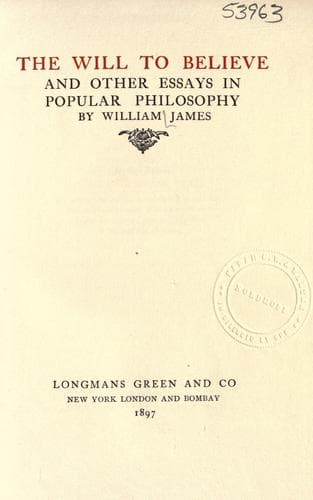
The Will to Believe, and Other Essays in Popular PhilosophyJames, William
Religion
The Will to Believe, and Other Essays in Popular Philosophy
James, William
Belief and doubt; Essays; Philosophy
Man's chief difference from the brutes lies in the exuberant excess of
his subjective propensities,--his pre-eminence over them simply and
solely in the number and in the fantastic and unnecessary character of
his wants, physical, moral, aesthetic, and intellectual. Had his whole
life not been a quest for the superfluous, he would never have
established himself as inexpugnably as he has done in the necessary.
And from the consciousness of this he should draw the lesson that his
wants are to be trusted; that even {132} when their gratification seems
farthest off, the uneasiness they occasion is still the best guide of
his life, and will lead him to issues entirely beyond his present
powers of reckoning. Prune down his extravagance, sober him, and you
undo him. The appetite for immediate consistency at any cost, or what
the logicians call the 'law of parsimony,'--which is nothing but the
passion for conceiving the universe in the most labor-saving
way,--will, if made the exclusive law of the mind, end by blighting the
development of the intellect itself quite as much as that of the
feelings or the will. The scientific conception of the world as an
army of molecules gratifies this appetite after its fashion most
exquisitely. But if the religion of exclusive scientificism should
ever succeed in suffocating all other appetites out of a nation's mind,
and imbuing a whole race with the persuasion that simplicity and
consistency demand a _tabula rasa_ to be made of every notion that does
not form part of the _soi-disant_ scientific synthesis, that nation,
that race, will just as surely go to ruin, and fall a prey to their
more richly constituted neighbors, as the beasts of the field, as a
whole, have fallen a prey to man.
Public-domain text, read in full here on John Shaqi.
Reviews
Reviews
No reviews yet
Be the first to share your thoughts on this work.
Elsewhere in the archive
Join the Discussion
Join the discussion
Sign in to leave a comment or review.
Sign InorCreate an account