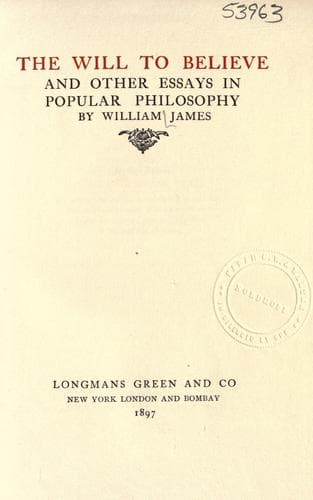
The Will to Believe, and Other Essays in Popular PhilosophyJames, William
Religion
The Will to Believe, and Other Essays in Popular Philosophy
James, William
Belief and doubt; Essays; Philosophy
I have myself little fear for our Anglo-Saxon race. Its moral,
aesthetic, and practical wants form too dense a stubble to be mown by
any scientific Occam's razor that has yet been forged. The knights of
the razor will never form among us more than a sect; but when I see
their fraternity increasing in numbers, and, what is worse, when I see
their negations acquiring almost as much prestige and authority as
their affirmations legitimately claim over the minds of the docile
public, I feel as if the influences working in the direction of our
mental barbarization were {133} beginning to be rather strong, and
needed some positive counteraction. And when I ask myself from what
quarter the invasion may best be checked, I can find no answer as good
as the one suggested by casting my eyes around this room. For this
needful task, no fitter body of men than the Unitarian clergy exists.
Who can uphold the rights of department Three of the mind with better
grace than those who long since showed how they could fight and suffer
for department One? As, then, you burst the bonds of a narrow
ecclesiastical tradition, by insisting that no fact of sense or result
of science must be left out of account in the religious synthesis, so
may you still be the champions of mental completeness and
all-sidedness. May you, with equal success, avert the formation of a
narrow scientific tradition, and burst the bonds of any synthesis which
would pretend to leave out of account those forms of being, those
relations of reality, to which at present our active and emotional
tendencies are our only avenues of approach. I hear it said that
Unitarianism is not growing in these days. I know nothing of the truth
of the statement; but if it be true, it is surely because the great
ship of Orthodoxy is nearing the port and the pilot is being taken on
board. If you will only lead in a theistic science, as successfully as
you have led in a scientific theology, your separate name as Unitarians
may perish from the mouths of men; for your task will have been done,
and your function at an end. Until that distant day, you have work
enough in both directions awaiting you.
Meanwhile, let me pass to the next division of our subject. I said
that we are forced to regard God as {134} the normal object of the
mind's belief, inasmuch as any conception that falls short of God is
irrational, if the word 'rational' be taken in its fullest sense; while
any conception that goes beyond God is impossible, if the human mind be
constructed after the triadic-reflex pattern we have discussed at such
length. The first half of the thesis has been disposed of.
Infra-theistic conceptions, materialisms and agnosticisms, are
irrational because they are inadequate stimuli to man's practical
nature. I have now to justify the latter half of the thesis.
Public-domain text, read in full here on John Shaqi.
Reviews
Reviews
No reviews yet
Be the first to share your thoughts on this work.
Elsewhere in the archive
Join the Discussion
Join the discussion
Sign in to leave a comment or review.
Sign InorCreate an account