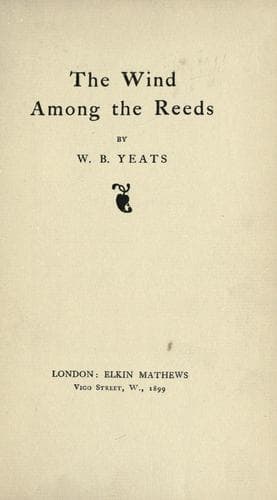
The Wind Among the ReedsYeats, W. B. (William Butler)
General
The Wind Among the Reeds
Yeats, W. B. (William Butler)
English poetry -- Irish authors
The powerful and wealthy called the gods of ancient Ireland the Tuatha
De Danaan, or the Tribes of the goddess Danu, but the poor called them,
and still sometimes call them, the Sidhe, from Aes Sidhe or Sluagh
Sidhe, the people of the Faery Hills, as these words are usually
explained. Sidhe is also Gaelic for wind, and certainly the Sidhe have
much to do with the wind. They journey in whirling winds, the winds that
were called the dance of the daughters of Herodias in the Middle Ages,
Herodias doubtless taking the place of some old goddess. When the
country people see the leaves whirling on the road they bless
themselves, because they believe the Sidhe to be passing by. They are
almost always said to wear no covering upon their heads, and to let
their hair stream out; and the great among them, for they have great and
simple, go much upon horseback. If any one becomes too much interested
in them, and sees them over much, he loses all interest in ordinary
things. I shall write a great deal elsewhere about such enchanted
persons, and can give but an example or two now.
A woman near Gort, in Galway, says: 'There is a boy, now, of the
Cloran's; but I wouldn't for the world let them think I spoke of him;
it's two years since he came from America, and since that time he never
went to Mass, or to church, or to fairs, or to market, or to stand on
the cross roads, or to hurling, or to nothing. And if any one comes into
the house, it's into the room he'll slip, not to see them; and as to
work, he has the garden dug to bits, and the whole place smeared with
cow dung; and such a crop as was never seen; and the alders all plaited
till they look grand. One day he went as far as the chapel; but as soon
as he got to the door he turned straight round again, as if he hadn't
power to pass it. I wonder he wouldn't get the priest to read a Mass for
him, or something; but the crop he has is grand, and you may know well
he has some to help him.' One hears many stories of the kind; and a man
whose son is believed to go out riding among them at night tells me that
he is careless about everything, and lies in bed until it is late in the
day. A doctor believes this boy to be mad. Those that are at times
'away,' as it is called, know all things, but are afraid to speak. A
countryman at Kiltartan says, 'There was one of the Lydons--John--was
away for seven years, lying in his bed, but brought away at nights, and
he knew everything; and one, Kearney, up in the mountains, a cousin of
his own, lost two hoggets, and came and told him, and he knew the very
spot where they were, and told him, and he got them back again. But
_they_ were vexed at that, and took away the power, so that he never
knew anything again, no more than another.' This wisdom is the wisdom of
the fools of the Celtic stories, that was above all the wisdom of the
wise. Lomna, the fool of Fiann, had so great wisdom that his head, cut
from his body, was still able to sing and prophesy; and a writer in the
Public-domain text, read in full here on John Shaqi.
Reviews
Reviews
No reviews yet
Be the first to share your thoughts on this work.
Join the Discussion
Join the discussion
Sign in to leave a comment or review.
Sign InorCreate an account